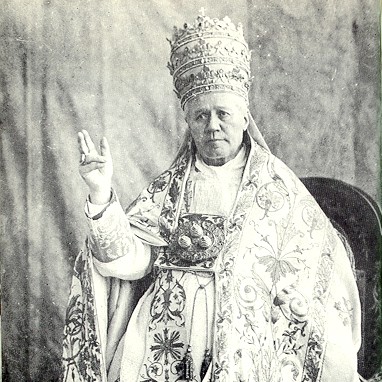
O Virgin Mary, our Lady of the Blessed Sacrament, - thou glory of the Christian people, joy of the universal Church - salvation of the whole world, pray for us, and awaken in all believers a lively devotion toward the Most Holy Eucharist, so that they may be worthy to partake of the same daily.
An indulgence of 500 days (Pius X, Audience, Dec. 9, 1906; S.C. Ind., Jan. 23, 1907; S.P. Ap., Dec. 12, 1933). From THE RACCOLTA.
APPENDIX 1 A COMPARISON OF THE CONSECRATION PRAYERS AS FOUND
IN:
(1) The Original Latin; (2) The Literal English Translation from the Latin;
(3) The New All-English Canon; (4) The Anglican Schismatics' "Book of Common
Prayer"
APPENDIX 2 "LEX CREDENDI: LEX ORANDI"
APPENDIX 3 ANSWERING SOME MORE OBJECTIONS
APPENDIX 4 INVALID CONSECRATION OF THE WINE INVALIDATES OR AT
LEAST CASTS DOUBT UPON THE CONSECRATION OF THE BREAD
APPENDIX 5 A SOLEMN DECREE OF THE ECUMENICAL COUNCIL OF
FLORENCE
APPENDIX 6 A LETTER OF POPE INNOCENT III
APPENDIX 7 A REPLY TO MONSIGNOR BANDAS
EPILOGUE by Rev. Lawrence S. Brey
Was October 22, 1967 the most ominous and
frightening day in the two-thousand-year history of the Catholic Church, and
certainly in the history of the Church in the United States of America?
Did that day see a legalized contradiction of hitherto inviolate decrees and
norms guarding the Canon of the Mass? Did it possibly even bring a new
era of darkness into the world, the extinguishing of the true sacrificial and
sacramental Eucharistic Christ from the majority of our churches?
During the early days of agitation for the
introduction of the Vernacular into the Mass, and even during the climax of
the movement, when the matter was debated at the First Session of Vatican
Council II (1962), Catholics were always assured that even if the vernacular
should be introduced, the Canon would remain untouched, in its
centuries-old, inviolate Latin form. And rightly so, for the
Canon is the heart and center and essence of the Eucharistic
Sacrifice. But since the 1963 Liturgy Constitution's granting of
permission to employ the vernacular in some parts of the Mass,
a literal cascade of subsequent changes and increased vernacularization has
now culminated in the introduction of the new, "English Canon," yielding what
is, in effect, an all-vernacular Mass, (notwithstanding Article 36 of that
same Constitution and the decrees of the Council of Trent). Thus, that
which was heretofore and for thirteen centuries considered inviolate
has now been touched and disturbingly altered. Something ominously
different from the Canon we have always known now occupies the heart and
center of our Catholic Worship.
Not since the introduction of the vernacular
in parts of the Mass in 1964, has so much protest, with so many
intense misgivings, been engendered, as has been by the introduction of this
new, English Canon. How, infinitely more thundering this protest would
be were it not for the fact that the clergy and the faithful have been
gradually "conditioned" by change after change in recent years, - perhaps to
the point of expecting change as the order of the day and the "mind of the
Church"!
There are three main classes of objections to
the new, English Canon: (1) That it contains many omissions, mistranslations
and distortions, which offend against Catholic reverence, piety, and the
integrity of the Faith. (2) That it is illicit, i.e., in violation of
enduring and unrescinded decrees and teachings of previous Councils and
Popes. (3) That it is invalid, i.e., that because of some radical
mutilation it no longer confects or produces the true Sacrifice and Sacrament
of the Eucharist. Such an alleged invalidity is by far the
gravest and most crucial of all the objections, though this view is not
shared by many or most of the Canon's critics. It is to the question of
the validity of the "new Canon" - in the light of a mutilation of the
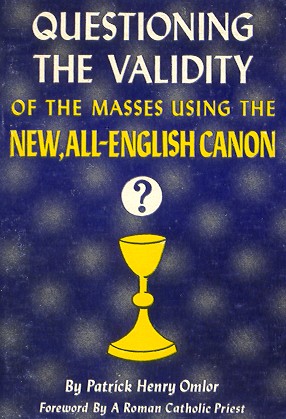
Form of Consecration - that Patrick Henry Omlor devotes this treatise,
"Questioning the Validity." We will come back to this
shortly.
Regarding the first two objections to the new
Canon - the faultiness of its translation and its alleged illicitness - much
has been said and written already. A cursory study of the new Canon
reveals approximately 50 omissions, 50 vague or inaccurate or distorted
translations of phrases, words or clauses; and five or more additions of
words or phrases not
heretofore in the Canon. In addition, three references to key
dogmas (the Divine Maternity of Mary, the Perpetual Virginity of Mary,
and the Divinity of Christ) have been deleted from places where they had been
explicitly incorporated in the text of the Canon. Other
doctrines, too, are deemphasized or bypassed by way of omissions and
mistranslations. A highly respected American theologian has stated that
he would "never touch" the new Canon, and that "true priests and laymen will
feel bound in conscience to continue to use the Latin (Canon), the sure norm
of orthodoxy."
Regarding the allegation that the new Canon is
in violation of several teachings and anathema-sanctioned canonical decrees
of the Council of Trent, and of later documents of the Magisterium, much also
has been heretofore presented, and the citations have yet to be refuted
conclusively. For example: the new Canon embodies violations of Trent's
prohibition of an all-vernacular Mass, and of the Canon being said aloud;
also an implicit repudiation of Trent's upholding the relevance and piety of
the ceremonies and external signs used in the Mass; and the Tridentine
doctrine of the Integrity and Perfection of the traditional Roman
Canon. "The Catholic Church," declared Trent, "in order that the Holy
Sacrifice may be offered . . . in a dignified and reverent way, established
the sacred Canon many centuries ago, so pure and free of all error that
nothing is contained in it which does not in the greatest way inspire
sanctity and certain piety, and raise the mind . . . to God . . . (The Canon
consists) of our Lord's very words, and of prayers received
from Apostolic tradition or piously ordained by the holy Pontiffs."
Adrian Fortescue observed: "The Council of Trent ordered that 'the holy Canon
composed many centuries ago' shall be kept pure and unchanged." It was
the pure Canon restored by St. Pius V, remaining as it was in the days of St.
Gregory I (6th century), and in fact going back far beyond his time into the
mists of the Church's first centuries. Further, the new English Canon
is in apparent violation of the Bull Quo Primum (1570) of St. Pius V,
binding "in perpetuity," as well as in violation of the Apostolic
Constitution, Veterum Sapientia (1962) of Pope John XXIII, and Article
36 of the Constitution on the Sacred Liturgy (1963).
So much for the first two classes of objections
to the new English Canon: the gross defects in its translation, and its
apparent illicitness. They are weighty and substantiated. But
as reprehensible and disturbing as they are, and thoroughly justifying
the NON-use of this Canon, they are not nearly so frightening and
catastrophic as are the implication of a third objection, namely, that the
new English Canon is INVALID. Some have made this charge on the
basis of the deletion of certain key dogmas from the Canon, other
mistranslations of the text, and the concomitant introduction of a so-called
"New Eucharistic Theology," which in effect denies transubstantiation and the
sacrificial nature of the Mass. However, given an accurately translated
form of Consecration, the invalidity of a Mass using the new English Canon
would, in spite of those factors, hinge on a defect of Intention on the part
of a given priest-celebrant. If a priest's intent, in consecrating, is
contrary to the "intention of the Church," then such a consecration would
indeed be invalid. But if, in consecrating, he, has the
intention of "doing what the Church does" (in consecrating), then
his consecration will be valid - even if personally he be a heretic, or have
no true Faith in the Eucharist or the true nature of the Mass. Thus,
defect of intention, but not defect of faith, would be the factor
invalidating his consecration - even if he used the traditional Latin
Canon!
But there is a more clear-cut criterion
on which arguments for or against the validity of the "new Canon" can be
based, and that is whether the form of the Sacrament as it is rendered
in the new "translation" (i.e., the words of Consecration), is valid
or invalid. "Matter" and "form" are the essential components of
the rite of a sacrament. Improper
matter or a defective form does indeed invalidate the Sacrament.
In the Sacrament of the Holy Eucharist the matter is the bread and the
wine, and the form consists of the words of Consecration. Since
the new Canon (obviously) does not touch upon the matter, it is to the
"new" form that we must look for possible defects and/or
mutilations. Even more necessary than the specific matter (the "thing":
res) is the specific form (the "words": verba), for the
form is the "determining element" of the matter. Thus a change
in the verba and their intent and meaning could imply the
"determining" of the res in a manner other than that intended by
Christ.
"Ideas have consequences!" an American
philosopher so sagely observed. And, as words convey ideas, we must
look to the words!
To this end, Patrick H. Omlor has
contributed his efforts in this present treatise. To date, his is
the first such study, to my knowledge, to demonstrate systematically and
to document the thesis that the new, English Canon is invalid by reason of
defect of form - specifically, by reason of a mutilation in the English
rendering of the Form for the Consecration of the Wine. I have
thoroughly read and studied his manuscript, and I sincerely feel that, his
study is worthy of serious consideration. It may well be crucial in
solving the problem of the new English Canon. And by the very fact
the question of the validity of the form has been raised, and
apparently on genuine grounds, the issue must be thoroughly studied
and resolved. For in the Sacraments, and above all in the Mass,
nothing less than absolute certainty, or the medium certum, must be
the norm governing their rites.
"We must see whether a change of words destroys
the essential sense of the words," writes St. Thomas Aquinas, "because then
the sacrament is clearly rendered invalid. (Summa Theologica,
III, Q. 60. Art. 8). Are there mutilations in the new English
form of Consecration, and do they destroy the "essential sense" of the
words? The author of this treatise answers these questions
affirmatively, in view of the deviations occurring in the "new form" for the
consecration of the wine.
The author demonstrates that these mutilations
delete the vital concept of the Eucharist's relationship to the
Mystical Body of Christ, that they delete the intended efficacy and
purpose of the Sacrament of the Holy Eucharist, and that they are a
falsification of Christ's words of Institution, which falsification
distorts His intention and purposes in instituting and confecting the
Sacrifice and Sacrament. He demonstrates that, as a necessary
consequence, the form has been substantially or essentially mutilated;
and that therefore the form has been rendered invalid; and, finally, that
therefore any Masses using this new "English Canon" are invalid.
To support his thesis Mr. Omlor draws heavily
on the teachings of St. Thomas Aquinas and the documents of the Magisterium
of the Church, particularly the Council of Trent. Of especial
importance are the passages he quotes from "The Catechism of the Council
of Trent," a compendium of official Catholic doctrine which enjoys
a unique and authoritative status - The Trent Catechism is "guaranteed to be
orthodox by the Catholic Church and her supreme head on earth" says Dr. John
Hagan of the Irish College in Rome.
St. Thomas Aquinas, as an authority on
Eucharistic theology, deserves profound respect. Indeed, the Angelic
Doctor received the singular endorsement of Christ Himself: "Bene
scripsisti de Me, Thoma!" - "You have written well of Me, Thomas!" -
words issuing from the Crucifix on the Altar before which Thomas was praying
in Naples, a year before his death. Only shortly before this had he
completed his treatise on the Eucharist. St. Thomas Aquinas is in a
special way the Theologian of the Eucharist. It was he who was
commissioned by the Pope to compose the Office and Mass for the Feast of
Corpus Christi. Before appealing to contemporary theologians to
"justify" the new, English Form of Consecration, must we not first study
most carefully the teachings of the angelic doctor on this most
vital of matters? "Bene scripsisti de Me, Thoma!"
The charge of invalidity of the new "English
Canon" is a grave charge indeed; one that may not be made lightly or
recklessly, and one that must be either totally refuted or totally
substantiated. Most reprehensible, most irresponsible, and most
harmful to souls would it be to make such a charge, or even raise the
question publicly, if there were no reasonable foundation for such a charge
or doubt. Likewise reprehensible would it be to ignore the
possibility of invalidity if concrete evidence of form mutilation can be
produced. As shall be shown, such evidence has been
produced. This present treatise is a systematic study of these
mutilations and their bearing on the entire form, and therefore on the
entire Mass.
In practice, the very raising of
questions or doubts about the validity of a given manner of confecting a
sacrament - if this question is based on an apparent defect of matter or form
- would necessitate the strict abstention from use of that doubtful manner of
performing the sacramental act, until the doubts are resolved.
In confecting the sacraments, all priests are obliged to follow the
"medium certum."
From all appearances, a real mutilation has
indeed been incorporated into the form of consecration in the new English
Canon, a mutilation that conveys an apparent mutilation of meaning and
concept. BUT, THE CHURCH NEVER CONTRADICTS HERSELF!
The Church never contradicts herself, as Christ never contradicts
Himself. For some ominous reason, present ecclesiastical developments,
highlighted by the introduction of the new English Canon, seem to have
slipped out of the hands of the Church's Magisterium! Was
October 22, 1967, the beginning of an age of new darkness on the earth, and
the harbinger of an unprecedented crisis within the Church? Was the
Blessed Virgin's indication that the Rosary and Her Immaculate
Heart would be our "last and final weapons" a hint that somehow
the Holy Mass would at some point become no longer available to most
Catholics?
The very fact that a question (let alone a
certainty has been raised concerning the validity of the new English
Canon and consecration form thoroughly vindicates the Church's
traditional, absolute insistence that the essential forms of the
sacraments always be pronounced only in the original Latin, as they
appear inviolably in the Roman Ritual, Roman
Missal, and Roman Pontifical. This insistence was aimed at
preventing the very crisis which has now arisen! That is to say,
it was aimed at safeguarding absolutely the integrity, essence and
intent of the forms from the danger of invalidating mutilations.
Secondly, it vindicates the Church's insistence
on the use of the teachings of St. Thomas Aquinas and Scholastic Philosophy,
the "ancilla theologiae" (handmaid of Theology).
Thirdly, and above all, it vindicates the
Church's insistence on the teachings of the Magisterium in these matters
pertaining to the Sacraments, and especially the decrees of the Sacred
Council of Trent and the Tridentine Catechism.
Can it be that we are now at last experiencing
the ultimate and most fearsome consequences of abandoning these three
providential instruments, in favor of vernacularism, muddled thinking and
"new theology"? Do we now find in imminent danger of destruction the
very heart and essence of our religion, the Holy Mass? With each of the
gradual and growing changes and vernacularizations of the Mass since 1963,
the proponents of change always assured us: "It's still the
Mass!" Has the time now come (or, if not, will it soon be
coming?) when, in truth, this can no longer be said?
I have written this Foreword, but what,
exactly, is my position? It is not a position of unqualified and
precipitous endorsement of Mr. Patrick Omlor's arguments and
conclusions. Rather is it a call to intense mutual study of his thesis,
and a serious examination of the very real mutilations introduced
in the form of Consecration and their bearing on the validity of the
Mass. If Mr. Omlor is wrong in his thesis and arguments, let him be
refuted beyond the shadow of a doubt! If he is correct, may
effective measures be taken immediately to restore the Mass, and place
it back into the hands of the Magisterium. Or may God Himself
intervene! If the matter remains in doubt, unsolved, then the only
course of action is to take the pars tutior, indeed the "medium
certum."
While considering the author's request that I
write and sign this Foreword, I wavered and prayed and made no immediate
decision. What finally decided the matter for me was my recollection of
Our Lord's words: "Every one therefore that shall confess me before men, I
will also confess him before my Father who is in heaven. But he that
shall deny me before men, I will also deny him before my Father who is in
heaven." (Matthew: 10,32-3). For the Mass and its integrity and
particularly the Consecration and the Most Holy Sacrifice and Sacrament of
the Body and Blood of the Lord, form the very heart and center of my
priesthood and of the Faith I swore to
profess, guard, and defend "to the last breath of my life."
This little monograph embodies the presentation
of a case against the validity of the new "form" presently being used for the
Sacrament of the Holy Eucharist. It was on October 22, 1967, that this
new "form" originally came into use in the United States, along with the new
English Canon of the Mass.
What I have striven for is clarity. Each
paragraph of this monograph is numbered uniquely, so that all who wish to
question or rebut any particular point, or many points, may with ease refer
to what I have written. Not only will this aid my sincere opponents in
citing chapter and verse against me, but it will also point up the
insincerity of all blanket criticisms that avoid citing
specifics.
That the arguments presented herein are beyond
question or challenge I do not claim. Assuredly they will not be the
"last word" on the subject.
"You must not so cling to what we have said,"
St. Anselm advised his disciple, "as to abide by it obstinately when others
with more weighty arguments succeed in overthrowing ours and establishing
opinions against them." When more weighty arguments (either for or
against mine) are advanced, I will welcome them. And I will take as my
own these words of the same great St. Anselm: "If there is anything that
calls for correction I do not refuse the correction."
Six Ways To Violate the Form of A Sacrament:
"NIL FORMAE DEMAS, NIL ADDAS, NIL VARIABIS, TRANSMUTARE CAVE, CORRUMPERE
VERBA, MORARI."
"Omit nothing of the form, add nothing, change nothing; Beware of
transmuting, corrupting, or interrupting the words."
(Quoted from J. M. Hervé's "Manuale Theologiae
Dogmaticae")
1) INTRODUCTION
2. According to the foregoing opinion, there are two criteria for determining whether any given, particular Mass is valid. And by virtue of Father De Pauw's use of the word: and, it is implied that both criteria must be answered affirmatively. The first criterion pertains to the faith of the priest, while the second concerns his proper intention.
3. Now, firstly, regarding the required faith of the priest, St. Thomas Aquinas teaches, "But if his faith be defective in regard to the very sacrament that he confers, although he believe that no inward effect is caused by the thing done outwardly, yet he does know that the Catholic Church intends to confer a sacrament by that which is outwardly done. Wherefore, his unbelief notwithstanding, he can intend to do what the Church does, albeit he esteem it to be nothing. And such an intention suffices for a sacrament: because as stated above the minister of a sacrament acts in the person of the Church by whose faith any defect in the minister's faith is made good." (Summa Theologica, Part III, Q. 64, Art. 9).
4. Therefore, from the above it would seem that the priest's faith in the sacrament of the Most Holy Eucharist is not required for the validity of the Masses he offers.
5. And, secondly, St. Thomas discusses "Whether the Minister's Intention is Required for the Validity of a Sacrament?", in Summa Th., III, Q. 64, Art. 8. As is generally known, the Angelic Doctor's method of exposition consists in first posing a number of "Objections," which he subsequently answers, after he has expounded the question at length. In the aforementioned article, the following "Objection" is posed. "Obj. 2 Further, one man's intention cannot be known to another. Therefore if the minister's intention were required for the validity of a sacrament, he who approaches a sacrament could not know whether he has received the sacrament."
6. His Reply Obj. 2 contains the following: "On this point there are two opinions. . . " St. Thomas next proceeds to discuss the first of these opinions, and exposes its flaws. Then he takes up the second of these opinions in the following manner: "Consequently, others with better reason hold that the minister of a sacrament acts in the person of the whole Church, whose minister he is; while in the words uttered by him, the intention of the Church is expressed; and that this suffices for the validity of the sacrament, except the contrary be expressed on the part either of the minister or the recipient of the sacrament." (Emphasis added)
7. Thus it would seem that there is no necessity for a layman explicitly to interrogate the priest concerning the latter's intention.
9. Although Father De Pauw mentions it only casually and in passing, it seems that this point is really the crux of the matter. For if the wording in the proper, established form of a sacrament is so altered that the essential meaning of the words is changed, then the sacrament is automatically rendered invalid, as will be demonstrated. For as St. Thomas teaches, "Some heretics in conferring sacraments do not observe the form prescribed by the Church: and these confer neither the sacrament nor the reality of the sacrament."(Summa Th., III, Q. 64, Art. 9).
10. As a consequence, both of Father De Pauw's criteria - as well as all other questions - are really beside the point if the Sacrament of the Holy Eucharist has been automatically rendered invalid by virtue of a defect in the form introduced in the new, all-English Canon of the Mass. And the investigation of this question is the purpose of this present monograph.
2) THE NECESSITY OF PROPER, DETERMINATE FORMS FOR SACRAMENTS
12. St. Thomas Aquinas explains why specific, determinate things are required for the proper matter of the sacraments: "Since, therefore, the sanctification of man is in the power of God Who sanctifies, it is not for man to decide what things should be used for his sanctification, but this should be determined by Divine institution. Therefore in the sacraments of the New Law, by which man is sanctified according to I Cor. vi. 11, "You are washed, you are sanctified," we must use those things which are determined by Divine institution." (Summa Th., III, Q. 60, Art. 5).
13. Thus no mere man may dare attempt to arrogate to himself the right to change the proper matter of a sacrament, for "we must use those things which are determined by Divine institution."
15. "As stated above, in the sacraments the words are as the form, and sensible things areas the matter. Now in all things composed of matter and form, the determining principle is on the part of the form. . . . Consequently, for the being of a thing the need of a determinate form is prior to the need of determinate matter. . . Since, therefore, in the sacraments determinate sensible things are required, which are as the sacramental matter, much more is there need in them of a determinate form of words." (Summa Th., III, Q. 60, Art. 7, emphasis added).
16. And so, similarly as above, mere men may not dare usurp the right to change the proper form of a sacrament.
3) THE PROPER FORM FOR THE SACRAMENT OF THE HOLY EUCHARIST
18. Prior to the introduction of the all-English Canon on October 22, 1967, the form used during the Mass was: For this is My body. This new Canon, however, omits the conjunction, for; and this particular word, according to St. Thomas, "is set in this form according to the custom of the Roman Church, who derived it from Peter the Apostle." (Summa Th., III, Q. 78, Art. 2, emphasis added). It was put in the form "on account of the sequence with the words preceding," the Angelic Doctor continues, "and therefore it is not part of the form." (Ibid.).
19. Although the omission of the word for in the consecration of the bread does not affect the validity of the sacrament, those who are responsible for this omission seemingly exhibit a callous disregard for a Tradition of the Roman Catholic Church, a Tradition dating from the very beginnings of Christianity. Indeed a Tradition "derived from Peter the Apostle."!
20. Interestingly, the Angelic Doctor also observes, "Thus in the form of the Eucharist, For this is My Body, the omission of the word for . . . does not cause the sacrament to be invalid; although perhaps he who makes the omission may sin from negligence or contempt." (Summa Th., III, Q. 60, Art. 8).
22. There are other theology books which either state (or at least imply) that the words This is My blood alone constitute the form. This certainly would seem to be incorrect for several reasons. First of all, as just noted, a catechism by decree of an Ecumenical Council (and not a "pastoral" one either) has declared otherwise.
23. The second reason is by the authority of long-established usage. For in practically all missals, both those used by the priest (altar missals) and those used by the faithful, we always find italicized or set in bold print the entire form: Hic est enim Calix . . . in remissionem peccatorum.
24. And finally, thirdly, we should believe that the entire form given in paragraph 21 above is the necessary and proper form, because the integrity of the expression demands it. "Some have maintained," says St. Thomas, "that the words This is the chalice of My blood alone belong to the substance (that is, the essence or necessary part - Auth.) of the form, but not those words which follow. Now this seems incorrect, because the words which follow them are determinations of the predicate, that is, of Christ's blood; consequently they belong to the integrity of the expression."
25. He continues, "And on this account others say more accurately that all the words which follow are of the substance of the form down to the words, as often as you shall do this (but not including these words - Auth.)" Otherwise, why would the priest continue holding the chalice until the completion of all these words? "Hence it is that the priest pronounces all the words, under the same rite and manner, namely, holding the chalice in his hands." (Summa Th., III, Q. 78, Art. 3).
26. To show why each clause and phrase is necessary, the Angelic Doctor explains them one by one. "Consequently it must be said that all the aforesaid words belong to the substance of the form; but that by the first words, This is the chalice of My blood, the change of the wine into blood is denoted. . ." It is important to note that St. Thomas says that the transubstantiation is denoted, but he does not say that it actually occurs, upon the completion of this clause.
27. Continuing, "but by the words which come after is shown the power of the blood shed in the Passion, which power works in this sacrament, and is ordained for three purposes. First and principally for securing our eternal heritage, . . . and in order to denote this, we say, of the New and Eternal Testament.
28. "Secondly, for justifying by grace, which is by faith, . . . and on this account we add, The Mystery of Faith.
29. "Thirdly, for removing sins which are the impediments to both of these things, . . . and on this account, we say, which shall be shed for you and for many unto the forgiveness of sins." (Quotations in paragraphs 26-29 from Summa Th., III, Q. 78, Art. 3).
30. To summarize this part: The proper form for the sacrament of the Most Holy Eucharist - all of which is necessary for its validity - is:
4) THE NEW "FORM" INTRODUCED VIA THE ALL-ENGLISH CANON
32. The new text reads: "This is my body. This is the cup of my blood, the blood of the new and everlasting covenant - the mystery of faith. This blood is to be shed for you and for all men so that sins may be forgiven."
34. But the alteration we shall analyze most carefully is the one that occurs in the final words. For you and for all men so that sins may be forgiven has been substituted for: For you and for many unto the forgiveness of sins.
35. If the above substitution is not a mere translation, but involves an essential change in meaning, then the sacrament has clearly been rendered invalid, as shall be shown, using St. Thomas as an authority.
36. For a plain understanding of what is to follow we must comprehend the language of St. Thomas. When he uses the expression, "substantial part of the sacramental form," or simply, "substance of the form," what is meant is the necessary part of the form. The alteration we are going to examine, as outlined in paragraph 34 above, occurs in the "substance of the form," as was shown above in paragraphs 24, 25 and 29, quoting St. Thomas.
37. By "essential sense of the words," it should be understood that St. Thomas means, "the basic meaning of the words."
5) HOW DOES CHANGING THE FORM INVALIDATE A SACRAMENT?
39. But it goes without saying that if the substance of the form is altered by the omission, then the sacrament is invalidated. As St. Thomas says: "Now it is clear, if any substantial part of the sacramental form be suppressed, that the essential sense of the words is destroyed; and consequently the sacrament is invalid." (Summa Th., III, Q. 60, Art. 8).
41. Another example of the addition of words which would render a sacrament invalid would be: "I baptize thee in the Name of the Father. . . etc., and of the Blessed Virgin Mary." That is, if by saying this one intended to place the Mother of God on a par with the Blessed Trinity.
42. If the words added involve no change of sense, then the sacrament remains valid. Thus the Greeks use the form: The servant of God, N . . . is baptized in the name of the Father, etc.
44. A substitution is permissible if the part inserted is exactly equivalent to the part taken out. The form we use for the Sacrament of Confirmation contains: I confirm thee with the chrism of salvation. But some say: I confirm thee with the chrism of sanctification. St. Thomas explains, "Holiness is the cause of salvation. Therefore it comes to the same whether we say chrism of salvation or of sanctification." (Summa Th., III, Q. 72, Art. 4). However, to substitute the word faith instead of salvation, for example, would most probably render the sacrament invalid.
46. That the change of words introduced in the new "form" has destroyed the "essential sense" of the words in the ancient, established form will be clearly demonstrated below in Part 7. But first of all, one more preliminary topic win be treated in the next part (6).
6) NECESSITY OF USING OUR LORD'S WORDS FOR THE EUCHARIST
48. In all the sacraments except the Holy Eucharist the minister has an act to perform in addition to pronouncing the required words of the form. For example, pouring water in Baptism, anointing with chrism in Confirmation, and in Holy Orders the imposition of hands, etc., which constitute the matter of that sacrament. But in the sacrament of the Holy Eucharist the priest has no act to perform except the pronouncing of the necessary words. (Summa Th., III, Q. 78, Art. 1).
49. Moreover, the power of the form of this sacrament is derived solely from the fact that the words spoken by the priest are the exact words of Our Lord. "But the form of this sacrament is pronounced as if Christ were speaking in person, so that it is given to be understood that the minister does nothing in perfecting this sacrament, except to pronounce the words of Christ." (Summa Th., III, Q. 78, Art. 1).
50. "Ambrose says (De Sacram.. iv): 'The consecration is accomplished by the words and expressions of the Lord Jesus. . . . (W)hen the time comes for perfecting the sacrament, the priest uses no longer his own words, but the words of Christ.'" (Summa Th., III, Q. 78, Art. 1).
52. Proof from Holy Scripture. As St. Thomas observes, "Nevertheless nearly all these words can be culled from various passages of the Scriptures." (Summa Th., III, Q. 78, Art. 3). In point of fact, the only words of this form which are not to be found in the Holy Scriptures are the following: (a) and eternal and (b) The Mystery of Faith.
53. But Tradition reveals to us that these words, and eternal and The Mystery of Faith were also from Our Lord. "The words added, namely, eternal and Mystery of Faith, were handed down to the Church by the apostles, who received them from Our Lord." (Ibid.)
54. And, elsewhere in discussing the question, "Whether the Words Spoken in This Sacrament Are Properly Framed?" (Summa Th., III, Q. 83, Art. 4), the Angelic Doctor makes this observation, "We find it stated in De Consecr., dist. 1, that 'James, the brother of the Lord according to the flesh, and Basil, bishop of Caesarea, edited the rite of celebrating the Mass.'"
55. To summarize: The words which had always been used for the form of the Sacrament of the Holy Eucharist were the words of Our Lord and Savior Jesus Christ, as proved from Holy Scripture and Tradition. These words were used by the Apostles themselves. It is by virtue of these words that the form for this sacrament derives its power and efficacy.
57. Moreover, all the evidence is that He did not say: "for all men," when instituting the Most Holy Sacrament. St. Matthew (26,28) writes that He said, "for many." And also St. Mark (14,24) records that Our Lord said, "for many." But nowhere in Holy Scripture - neither in St. Paul nor the Evangelists - do we find that Our Lord said, "for all men." Now whom are we to believe? Are we to believe St. Mark and St. Matthew, who was actually there at the Last Supper (and both of whom were divinely inspired to write what they wrote)? Or, are we to believe an "enlightened" clique of mid-twentieth-century Modernists and Innovators?
58. Even in ordinary writing or oratory, careful scholars are diligent in using the exact words of another person whenever attributing to him a quotation. How much more diligence is demanded when attributing a direct quote to Jesus! "It is not lawful to add even words to Holy Scripture as though such words were a part thereof, for this would amount to forgery." (Summa Th., III, Q. 60, Art. 8).
59. Now, the authors of this new Canon boldly claim that Our Lord said something that He clearly and obviously did not say. (In Part 12 it will be shown that Our Lord could not have said what they claim He did.) The text of this new Canon reads precisely: "He . . . gave the cup . . . AND SAID:". The "quotation" immediately following includes the bogus phrase: "for all men so that sins may be forgiven." THIS IS A FORGERY, and those who are responsible for it must be deemed guilty of a deliberate deception, unless they can prove that they are merely completely inept and most culpably negligent.
60. It might be remarked, in passing, that the phrase for you and for all men grammatically is inelegant in that it is redundant. By analogy, a speaker does not single out one person in a group and say, "This is for you and for all in this room," but rather would he say, "This is for you and for all others in this room." For it is obvious that the person who is singled out is automatically included in "all in this room." Thus the Innovators even go so far as to attribute inferior rhetoric to Our Lord.
61. From the foregoing it is clear that, by tampering with the words of Our Lord, our Modernists are endangering the very source of the power of this sacrament.
7) THE NEW "FORM" DESTROYS THE SENSE OF THE PROPER FORM
63. The first aspect is that of sufficiency; that is, for what and for whom did Christ's Passion suffice? The second aspect is that of efficacy; that is, for what and for whom was Christ's Passion efficacious (effective)?
65. Hence we can say that Christ's Passion is the sufficient cause of the salvation of all men. In the words of St. Thomas, "Christ by His Passion delivered us from our sins causally - that is, by setting up the cause of our deliverance, from which cause all sins whatsoever, past, present, or to come, could be forgiven: just as if a doctor were to prepare a medicine by which all sicknesses can be cured even in the future." (Summa Th., III, Q. 49, Art. 2).
66. And this is the meaning of the truth, "Christ died for all men." His Passion is sufficient for the salvation of all, "from which cause all sins . . . could be forgiven."
68. This other truth we are led to consider is that the efficacy, or effectiveness, of Christ's Passion is not communicated to all men, but only unto those who are actually saved; that is, to the elect. This truth is closely connected with the doctrine of man's free will, a mystery, and with the doctrine of the Mystical Body of Christ, also a mystery.
69. These two distinct aspects of Christ's Passion and Death (each conveying its own particular truth) - to wit, the standpoints of sufficiency and efficacy - are clearly distinguished in this passage from a decree of the Council of Trent: "But, though He died for all, yet all do not receive the benefit of His death, but those only unto whom the merit of His passion is communicated." (Session VI, Ch. 3).
71. A first observation is that the word unto - (which in Latin is the preposition "in" followed by a noun in the accusative case) - means to, towards, or leading up to; and thus this word unto in itself conveys the sense of effectiveness or efficacy.
72. Secondly, the words for many are selective in their connotation, as opposed to for all men, which phrase denotes universality. At this point it will be most instructive to rely once again upon the lucid teaching of the Angelic Doctor. The following argument is drawn from Summa Th., III, Q. 78, Art. 3; - and this particular article is very much to the point of our discussion, for the topic treated therein is: what is the proper form for the consecration of the wine?
73. According to his characteristic manner of exposition, St. Thomas at first suggests a number of "objections," and subsequently he demonstrates the errors contained in these "objections." The following objection is posed: "Obj. 8. Christ's Passion sufficed for all; while as to its efficacy it was profitable for many. Therefore it ought to be said: which shall be shed for all, or else for many, without adding for you."
74. For clarity's sake, let us examine this "objection" by rephrasing it. It may be reworded thus: The proper form for the consecration should treat of Christ's Passion from either the standpoint of sufficiency, or the standpoint of efficacy. Now to treat of it from the standpoint of sufficiency demands the form, which shall be shed for all. But if the standpoint of efficacy is what is meant, then the form should be simply: for many, without adding for you (which is redundant).
75. The subtle error in this "objection" is thus exposed and refuted by St. Thomas: "Reply Obj. 8. The blood of Christ's Passion has its efficacy not merely in the elect among the Jews, to whom the blood of the Old Testament was exhibited, but also in the Gentiles . . . And therefore He says expressly, for you, the Jews, and for many, namely the Gentiles . . . "
76. Beginning his reply, "The blood of Christ's Passion has its efficacy," St. Thomas totally ignores the aspect of sufficiency, and thus he implies that it goes without saying that the proper sense of Christ's words here is that of efficacy. Moreover, his reply speaks only of "the elect." Thus, for you means not only the Apostles to whom Christ was speaking - and, in fact, Judas, though present, was not included in for you - , but it means all the elect among the Jews. Not all the Jews, but only "the elect" among the Jews. And this phraseology, needless to say, denotes only the aspect of efficacy. And the phrase and for many encompasses the Gentiles; again it is understood, of course, that St. Thomas is referring only to the elect among the Gentiles.
77. Therefore according to the Angelic Doctor's explanation, the correct sense or meaning of the form for the consecration of the wine is: which shall be shed for you (the elect among the Jews) and for many (the elect among the Gentiles) unto (effecting) the forgiveness of sins. And from this it should be abundantly clear that this form denotes the shedding of Christ's Blood from the aspect of its efficacy, rather than its sufficiency.
78. "As Christ's Passion benefits all" says St. Thomas elsewhere, ". . . whereas it produces no effect except in those who are united with Christ's Passion through faith and charity, so likewise this sacrifice, which is the memorial of our Lord's Passion, has no effect except in those who are united with this sacrament through faith and charity. . . Hence in the Canon of the Mass no prayer is made for them who are outside the pale of the church." (Summa Th., III, Q. 79, Art. 7, emphasis added).
79. But if no prayer is made anywhere in the Canon of the Mass for those outside the Church, least of all should the words "for all men" be placed in the very form for the Consecration! For, as shall be explained later, this Most Holy Sacrament of the Eucharist is uniquely the Sacrament of the Mystical Body of Christ, of which Body not all men are members.
81. The very words, "so that sins may be forgiven," denote only the notion of possibility, for the verb "may" is the permissive form. To describe sufficiency, St. Thomas uses the words, "from which cause all sins . . .could be forgiven." The word "may" is akin to "could", except that "could" is even stronger in that it denotes power, capability, or ability, and not mere possibility.
82. Secondly, as stated earlier, the phrase "for all men," by its universality, cannot denote anything but the aspect of sufficiency. Thus it is proved that the new "form" in no way conveys the same meaning as the ancient and proper form.
83. It is important to note, in passing, that if the words all men had been substituted for the word many, without changing anything else, the "form" would have read: which shall be shed for you and for all men unto the forgiveness of sins. This "form" is heretical. Since unto denotes efficacy, this "form" says that the benefits of Christ's Passion are actually communicated to all men unto the forgiveness of sins. And this is contrary to faith.
85. The ancient and proper form for the Sacrament of the Holy Eucharist uses Christ's own words and conveys the latter truth; namely, that of efficacy. The new "form" uses men's words and conveys the former truth; namely, that of sufficiency. And thus the Innovators, the authors of this change, have destroyed the essential sense of the proper form.
86. "For since in the sacraments, the words produce an effect according to the sense which they convey, as stated above, we must see whether the change of words destroys the essential sense of the words: because then the sacrament is clearly rendered invalid." (Summa Th., III, Q. 60, Art. 8).
8) WHAT IS MEANT BY "THE REALITY" OF A SACRAMENT?
87. Earlier in this monograph this quotation of St. Thomas was cited, "Some heretics in conferring sacraments do not observe the form prescribed by the Church: and these confer neither the sacrament nor the reality of the sacrament." What does the Angelic Doctor mean by "the reality" of a sacrament? For a clear understanding of what is to follow in this monograph, it is imperative that this fundamental concept - that is, "the reality" of a sacrament - be grasped.
90. And (2) there is the element which is the reality only; that is, the chief fruit or grace proper to the Sacrament of Baptism. This crowning effect is the washing away of original sin (and, in the case of adults, actual sin also). In the words of St. Thomas, this chief effect - the reality of this sacrament - is "inward justification." This inward justification can be lost. It is clear, then, that "the reality" is the element which is signified.
91. And, finally, (3) the element which is both sacrament and reality, sometimes called "the reality and the sign, is the Baptismal character imprinted on the soul. This character cannot be lost; it is indelible. It must be noted that this third element both signifies and is signified. First of all, it signifies (or is the sign of) the aforesaid inward justification. And, lastly, it is signified by the aforesaid outward washing.
9) WHAT IS "THE REALITY" OF THE SACRAMENT OF THE HOLY EUCHARIST?
93. Now, what is "the effect of this sacrament," the reality of the Holy Eucharist? "Now . . . the reality of the sacrament is the unity of the mystical body, without which there can be no salvation." (Summa Th., III, Q. 73, Art. 3).
94. The key idea in what is to follow is the unique relationship between the Sacrament of the Holy Eucharist and the Mystical Body. Let us reiterate this idea, using the words of Abbé Anger: "In the Eucharist the sign is the consecrated species; the 'reality and the sign' is the true Body of Christ; and the 'reality' is the Mystical Body or the grace uniting the soul with Christ and with the members of Christ." (Anger-Burke, "The Doctrine of the Mystical Body of Christ, According to the Principles of the Theology of St. Thomas," by Abbé Anger, and translated from the French by Rev. John J. Burke, C.S.P., S.T.D., p. 107).
96. This is answered as follows. By Baptism a person "is ordained to the Eucharist, and therefore from the fact of children being baptized, they are destined by the Church to the Eucharist; and just as they believe through the Church's faith, so they desire the Eucharist through the Church's intention, and, as a result, receive its reality." (Summa Th., III, Q. 73, Art. 3, emphasis added).
97. Therefore infants, though they do not receive the sacrament of the Eucharist, nevertheless receive the reality of the sacrament, namely, union with the Mystical Body.
98. Similarly, one who with the right disposition, though he be unable to receive Holy Communion, makes a "spiritual communion," thereby receives the reality of the sacrament, but not the sacrament itself.
10) THE UNIQUE RELATIONSHIP BETWEEN THE EUCHARIST AND THE MYSTICAL BODY
100. "In the Catholic doctrine of the sacraments everything converges, everything looks towards the Eucharist, effective symbol of the unity of the Mystical Body." (Anger-Burke, p. 163).
102. "The Holy Eucharist brings us to the very heart of our subject . . . it is that by which the Mystical Body is actually constituted." (Anger-Burke, p. 104).
103. "This is the unity of Christ and His members, and of His members one with another. This is what theologians term 'the reality' of this sacrament. This is the fruit of the Holy Eucharist. (Anger-Burke, p. 117).
104. "The Holy Eucharist is the center of the doctrine of the Mystical Body . . . The Holy Eucharist is called 'union with' and indeed that is what it effects . . . By it we are united to Christ . . . By it we are also united one to another and brought into one sole body." (Anger-Burke, p. 128).
105. And finally, "Everything touching the Eucharist leads us back to the Mystical Body." (Anger-Burke, p. 107).
107. And elsewhere in this same encyclical the Pontiff says, "It seems to Us that something would be lacking . . . if We did not add here a few words on the Holy Eucharist, wherein this union during this mortal life reaches, as it were, a climax.
108. "Through the Eucharistic Sacrifice Christ Our Lord wished to give special evidence to the faithful of our union among ourselves and with our divine Head . . . For here the sacred ministers act in the person not only of our Savior but of the whole Mystical Body."
110. But what is the Mystical Body? Who are the members of the Mystical Body? Do all men belong to the Mystical Body? In the form for the Most Blessed Sacrament - at the very moment of the Consecration - should the words "for all men" be brought in? By saying "for all men" instead of "for many," is some part of the essential signification of the sacrament suppressed or perverted? Does the phrase "for all men" run counter to the "reality" of this sacrament? These are some of the questions that shall be treated of in Parts 11 and 12.
11) WHO BELONGS TO THE MYSTICAL BODY?
111. To give an exhaustive treatment of the doctrine of the Mystical Body, which is a great mystery of our Faith, is not the purpose of this part. Nor is this author even capable of such a task. On the contrary, the purpose here is simply to get a concise, working "definition" of the Mystical Body; and, further, to ascertain whether "all men" can, in any sense, be considered to be members of the Mystical Body. All quotations in this part are from the encyclical, Mystici Corporis Christi.
114. "For this reason We deplore and condemn the pernicious error of those who conjure up from their fancies an imaginary Church, a kind of Society that finds its origin and growth in charity, to which they somewhat contemptuously oppose another, which they call juridical."
12) THE NEW "FORM" SUPPRESSES WHAT IS ESSENTIAL, AND SIGNIFIES FALSELY
120. From the very choice of words by which the new "form" assumes its invalidity - namely, the substitution: for all men, etc. - additional evidence of its invalidity may be adduced. For these ersatz words, "for all men" attack the reality of the sacrament, which is the Mystical Body.
121. The Sacrament of the Holy Eucharist is not a sacrament "for all men"; it is the Sacrament "for you and for many." "The additional words for you and for many," teaches THE CATECHISM by Decree of THE HOLY COUNCIL OF TRENT, "are taken, some from Matthew, some from Luke, but were joined together by the Catholic Church under the guidance of the Spirit of God."
122. "With reason, therefore, were the words for ALL not used," continues THE CATECHISM, "as in this place the fruits of the Passion are alone spoken of, and to the elect only did His Passion bring the fruit of salvation. And this is the purport of the Apostle when he says: Christ was offered once to exhaust the sins of many; and also the words of Our Lord in John: I pray for them: I pray not for the world, but for them thou hast given me, because they are thine."
123. Always this was understood to be the meaning of this form; that is to say, that the sense of efficacy, and not sufficiency, must be conveyed. St. Alphonsus writes, "The words Pro vobis et pro multis ("For you and for many") are used to distinguish the virtue of the blood of Christ from its fruits; for the blood of our Savior is of sufficient value to save all men, but its fruits are applicable only to a certain number and not to all, and this is their own fault. Or, as the theologians say, this precious blood is (in itself) sufficiently (sufficienter) able to save all men, but (on our part) effectually (efficaciter) it does not save all - it saves only those who co-operate with grace. This is the explanation of St. Thomas, as quoted by Benedict XIV." (St. Alphonsus de Liguori, Treatise on THE HOLY EUCHARIST.).
124. As recorded in John (chs. 14-17), immediately after instituting the Holy Eucharist, Our Lord gave a lengthy discourse to the Apostles in which He expounded the doctrine of His Mystical Body. "I am the vine; you the branches." (John, 15,5). Significantly, Judas Iscariot was not present for this discourse, for he had already departed to betray The Master. And herewith lies an idea of vital import!: Jesus at this time did not pray for all men. "I pray for them: I pray not for the world, but for them whom thou hast given me." (John, 17,9). What further evidence is necessary to prove that Our Lord did not say, "for all men," as the authors of the new, bogus Canon sacrilegiously claim?
125. And since this new "form" contains a lie and a sacrilegious mutilation of the words of Christ as recorded in Holy Writ, how can it conceivably be a valid form for this Most Holy of Sacraments? "The Holy Ghost never inspires anything that is not conformable to Holy Writ. If there were the slightest divergence, that, alone by itself, would suffice to prove so evidently the work of the Evil One that were the whole world to assure me it was the Holy Ghost, I would never believe it." (Words of St. Teresa, quoted from Christendom, Feb. 1968). "But though we, or an angel from heaven, preach a gospel to you besides that which we have preached to you, let him be anathema." (Gal. 1,8).
127. "Moreover," the Bull states, "it is well known that the sacraments of the New Law, being sensible signs which cause invisible grace, must both signify the grace which they cause and cause the grace which they signify. Now this signification, though it must be found in the essential rite as a whole, that is, in both matter and form together, belongs chiefly to the form."
128. One aspect of the Anglicans' defective form centered around a change they made, which change might at first sight seem to be only minor or accidental in nature. Nevertheless, Pope Leo ruled that this particular change away from the proper, prescribed form entailed the suppression of some of the essential signification of the sacrament.
129. This was the change referred to just above: In their "new form" for the Sacrament of Holy Orders, the Anglicans deleted any special reference to the Sacrament of the Holy Eucharist. Included in their "form" however, was the phrase: and be thou a faithful dispenser . . . Of His Holy Sacraments, and also: Take thou authority . . . To minister the holy sacraments.
130. The Pontiff decreed that by failing explicitly to mention the Holy Eucharist, this "form" failed to contain some signification essential for the sacrament of Holy Orders. "It is, then, impossible" said Pope Leo, "for a form to be suitable and sufficient for a sacrament if it suppresses that which it ought distinctively to signify."
131. The Anglican Hierarchy countered by claiming that their wording - to wit, "of His Holy Sacraments" - automatically included the Holy Eucharist. This argument was answered by the Catholic Bishops of England as follows: "(N)or, although the sacrifice is intimately connected with one of the Sacraments, do the words Be thou a faithful dispenser . . . Of His Holy Sacraments draw special attention to that particular Sacrament, still less bring into prominence its sacrificial aspect." (A Vindication of The Bull 'Apostolicae Curae').
133. But where is this signification to be found? First of all, in the matter, the bread and wine, the Mystical Body is symbolized. As many have observed (see, for example, Summa Th., III, Q. 74, Art. 1), the many members of the Mystical Body, and their union, are signified by the many grains of wheat which compose the bread and the many grapes that go into the wine.
134. But Pope Leo has reminded us that the signification "belongs chiefly to the form"; and the Bishops' Vindication further states that the signification "must be found in the essential part, in the matter and form morally united together." Therefore we must attempt to discover where in the form of the Sacrament the Mystical Body is signified.
136. Now I would like to proffer an opinion on this subject. It seems that the words "This is My Body. This is My Blood," and these words alone, do not signify "the reality" of the Sacrament (The Mystical Body), but rather do they signify "the reality and the sign," which is Christ's true Body. And, needless to say, Christ is not the Mystical Body; He is the Head of the Mystical Body.
137. Therefore, This is My Body. This is My Blood," alone, signify only The Head, Christ, but fail to signify the members of the Mystical Body. But the whole Mystical Body, Head and members, must be signified in the form for this Sacrament, as observed just above in par. 132. "But now there are many members indeed, yet one body." (I Cor. 12,20) And also: "Nor again (can) the head (say) to the feet: I have no need of you." (I Cor. 12,21).
138. As a consequence it seems evident that this latter signification, of the members of the Mystical Body, is to be found in the words, "for you and for many."
139. Most certainly this exact phraseology is not required to convey this signification (more on this below), and even simply the words "for you" would suffice to signify the members of the Mystical Body. And it is important to note well that all Scriptural accounts of the institution of the Holy Eucharist contain this signification of the members of the Mystical Body.
140. Thus Sts. Matthew and Mark record "for many." St. Luke records: "This is my body, which is given for you," and also "This is the chalice, the new testament in my blood, which shall be shed for you." And, finally, we see that St. Paul also hands down a form which contains this essential signification: "Take ye, and eat: this is my body, which shall be delivered for you." (I Cor. 11,24).
142. It may be reiterated that this "form": for you and for all men so that sins may be forgiven, not only is not heretical, but, as stated earlier, it conveys a certain particular truth. But in the context in which it has been placed, in the "form" for The Eucharist, it conveys a falsehood, and also an implicit heresy: the denial of the doctrine of The Mystical Body of Christ. A paradox indeed! And it is the work of the Father of Lies to convey a falsehood by stating a truth!
144. After Pope Leo XIII had declared Anglican Orders invalid, the Anglican Hierarchy argued that there are liturgies which Rome has always acknowledged as having a valid form for the Sacrament of Holy Orders, but which do not employ the exact form used in the Roman Rite.
145. This objection was answered by the Catholic Bishops of England: "But you are also mistaken in thinking that matters have been left by Our Lord in so much uncertainty, and that there is no one definite form which has prevailed in the Catholic Church, both in the East and in the West. If, indeed, you mean merely that no identical form of words has always and everywhere been in use, but that, on the contrary, several different forms of words have been recognized by the Holy See as sufficient, you say what all will admit, and the Bull nowhere denies. The Bull, however . . . is requiring, not that the form should always consist of the same words, but that it should always be conformed to the same definite type." (Vindication of the Bull 'Apostolicae Curae'; emphasis in the original).
146. Consequently, although there is some variation in the wording in the examples which follow next, it is quite clear that they all conform to the "same definite type"; that is to say, they all contain the essential signification of The Mystical Body. (The parenthesized comments are mine.)
152. The Armenian form contains the following: "This is my Body, which for you and for many is given for remission and pardon of sins."
153. In the Liturgy of St. Basil we find: "This is my Body, which is broken for you unto the remission of sins." And for the wine: "This is my Blood of the New Testament, which is shed for you and for many for the remission of sins."
154. The Coptic Liturgy of St. Cyril has: "For this is my Body, which shall be broken for you, and for many shall be given for the remission of sins." As O'Brien observes, "The form according to the Liturgy of St. James is almost word for word like this; and . . . the Liturgy of St. Chrysostom differs hardly in anything from our own." (O'Brien, op. cit., p. 335).
155. It is in an Ethiopic Liturgy, called the Athanasian, that we find a unique and perhaps the most eloquent signification of the Mystical Body. "This bread is my Body, from which there is no separating. This cup is my Blood, from which there is no dividing." Clearly the Body "from which there is no separating" can mean only the Mystical Body. For since we are united to Christ's true Body only at the time of Holy Communion, it is incorrect to say of us that "there is no separating" from Christ's true Body.
157. For the consecration of the bread, the Mozarabic Missal adheres to the text of St. Paul (I Cor. 11,24), and thereby expresses the signification of the members of the Mystical Body through the words, "for you": This is my body which shall be delivered for you. And for the wine it has the familiar "for you and for many (pro vobis et pro multis)." (Source: Duchesne, op. cit., p. 216).
159. Also we have seen (par. 132) that the form for the Sacrament of the Holy Eucharist must contain some essential signification of the whole Mystical Body, Head and members. That the matter of the Sacrament contains this symbolism was pointed out.
160. The author expressed his opinion that in the Roman Rite this vital signification of the members of the Mystical Body is to be found in the words, for you and for many. But by saying, for you and for all men, the new, all-English Canon thwarts this essential signification and at the same time actually conveys a false signification.
161. Against the opinion of those who aver that the words This is My Body. This is My Blood, taken alone, suffice for the sacrament, the following evidence was submitted: (a) These words do not signify the Mystical Body, but Christ's true Body; (b) Every scriptural account of the Eucharist's institution contains some additional words referring to the Mystical Body; (c) No authentic and valid consecration form, anywhere, contains only the words This is My Body. This is My Blood; and (d) All consecration forms accepted as valid contain words with signification of the Mystical Body. Numerous examples from different liturgies were cited as examples.
13) ANSWERING SOME OBJECTIONS
163. This Part will consist of the raising of some possible objections to or arguments against some of the points set forth in this monograph, followed by the author's attempt to answer the said objections or arguments.
166. Secondly, until a noisy and dedicated clique of Modernists and "Progressives" undertook the task of downgrading St. Thomas, he had always been regarded as the authority par excellence. In their encyclicals, decrees, etc., no Pope of memory has failed to quote the Angelic Doctor at one time or another. As to Pope Pius V, he is, of course, a canonized saint; and therefore it follows that his only "biases" were towards those things which are good.
175. Thirdly, (c) the mutilation in question (to wit, "for all men so that, etc.") is a forgery of Christ's words recorded in Holy Writ, which forgery conveys a meaning totally foreign to and in conflict with the true meaning of the reality of this sacrament, which is the union of the Mystical Body.
176. Furthermore (d) the same authority Noldin goes on to say in paragraph 122 that the words of consecration must be pronounced without mutation either of the essential part or the incidental part. "Verba consecrationis proferenda sunt sine mutatione tum sunstantiali tum accidentali," (Noldin's emphasis).
177. Also, (e) St. Alphonsus calls to our attention the following from the rubrics of the Missal: "If anyone abbreviates or changes something of the form of consecration, and the words do not signify the same thing, he does not confect the Sacrament." ("Si quis autem aliquid diminueret vel immutaret de forma consecrationis, et verba idem non significarent, non conficeret sacramentum.")
178. And, finally, therefore (f) even if we grant, for argument's sake, that the words This is My Blood, alone, would suffice for the consecration of the wine, it is amply manifest from all sources that the "essential part" (whatever it may be) coupled with a mutation at least places the validity of the sacrament in doubt. Moreover, it is also universally agreed that this is always a grave sin on the part of the priest. Thus St. Alphonsus states: "graviter tamen peccaret qui aliqua ex reliquis omitteret vel mutaret"; that is, "nevertheless he would gravely sin who would omit or change anything of the remaining words." (By "remaining words" St. Alphonsus means here all those words which follow This is the Chalice of My Blood.).
183. That Father O'Brien would actually use Benedict XIV and St. Thomas as authorities to prove his point is incredible! Because they both held exactly the opposite of what Father O'Brien is trying to "prove." This quotation of St. Alphonsus (who has never been suspected of being a Calvinist) needs repeating here: "The words Pro vobis et pro multis ('For you and for many') are used to distinguish the virtue of the blood of Christ from its fruits; for the blood of our Savior is of sufficient value to save all men, but its fruits are applicable only to a certain number and not to all, and this is their own fault. . . . This is the explanation of St. Thomas, as quoted by Benedict XIV." (Emphasis added).
184. Readily is it granted that any "theologian" who has not grasped the fundamental difference between the aspects of sufficiency and efficacy most certainly would himself be prone to fall into "Calvinistic errors" as well as a whole host of other errors. Witness the example of the all-English Canon. Now in this present situation the majority of the American Bishops clearly and obviously are tolerating (and, indeed, in some cases abetting,) unorthodox theologians of this caliber. No truly orthodox Roman Catholic who is desirous of saving his soul can sit by idly and tolerate this assault from within upon THE Faith and upon the One, True, Holy, Catholic, Apostolic, Roman Church.
189. Elaborating further in the Vindication of the Bull, the English Bishops said, "It could not have been, as you seem to suggest, because the Reformers wished to go back to what was primitive, for they cut out with an unsparing hand the most ancient as well as the most modern portions of the Catholic rite." (Emphasis added).
192. "Where, however," Father Clark continues, "a new liturgical form is introduced and no such canonized formula is employed (and since it signifies falsely, the form: "for all men so that, etc." cannot become canonized legitimately - Auth.), there cannot be certainty of its validity until its credentials have been established, and it has been acknowledged, expressly or implicitly, by the universal Church." (Francis Clark, S.J., Anglican Orders and Defect of Intention, pp. 182-3, emphasis added).
195. According to Cardinal Newman, on the eve of the Council of Nicaea, when all the world was "going Arian," eighty percent of the bishops were fully prepared formally to deny the Divinity of Christ. This wholesale apostasy was averted only because Almighty God chose to raise up at that moment His instrument, that eloquent and incomparable soldier of Jesus Christ, St. Athanasius.
196. A writer in The Wanderer (Feb. 22, 1968) repudiates comparisons between the conduct of our present-day Bishops and that of the 16th century English Bishops who were "an apostate Hierarchy" and "had previously broken off communications with Rome and were excommunicated." Perhaps this writer is awaiting a formal announcement in The New York Times. If our Bishops have invalidated one of the seven sacraments instituted by Our Lord Jesus Christ, they have thereby, in effect, denied that Sacrament. By denying this particular Sacrament one corrupts the dogmas of The Real Presence, Transubstantiation as defined by the Council of Trent, and the doctrine of The Mystical Body of Christ. St. Thomas Aquinas defines heresy as "a species of unbelief, belonging to those who profess the Christian faith, but corrupt its dogmas." (Summa Th., II-II, Q. 11, Art. 1).
199. "But both have the same origin in 'the enemy who,' ever alert for the perdition of men, 'has oversowed cockle among the wheat' (Matt. 13, 25); of both revolts the ways are hidden and darksome, with the same development and the same fatal issue. . . . Truly a spectacle full of sadness for the present and of menace for the future . . . especially for those who foment with the most activity or who tolerate with the most indifference this pestiferous wind of impiety." (Encyclical letter Editae Saepe, May 26, 1910, emphasis added).
200. This same Saint Pius X, the humble Giuseppe Sarto, when congratulated by his Mother upon his appointment as Bishop of Mantua, replied to her: "Mother, you do not realize what it means to be a Bishop. I shall lose my soul if I neglect my duty." May Almighty God raise up for us today Athanasiuses and John Fishers!
203. No priest can be forced to use this new "Canon," He can always have recourse to the decree Quo Primum, issued on July 19, 1570, by Pope Saint Pius V, which states inter alia:
"We determine and order by this Our decree, to be valid in perpetuity, that never shall anything be added to, omitted from or changed in this Missal . . .
"Specifically do We warn all persons in authority, of whatever dignity or rank, Cardinals not excluded, and command them as a matter of strict obedience never to use or permit any ceremonies or Mass prayers other than the ones contained in this Missal . . . (This decree, in its entirety, is printed in every official altar missal.)
"At no time in the future can a priest, whether secular or order priest, ever be forced to use any other way of saying Mass. And in order once and for all to preclude any scruples of conscience and fear of ecclesiastical Penalties and censures, We declare herewith that it is by virtue of Our Apostolic Authority that We decree and prescribe that this present order and decree of Ours is to last in perpetuity, and never at a future date can it be revoked or amended legally. . .
"And if, nevertheless, anyone would ever dare attempt any action
contrary to this order of Ours, handed down for all times, let him
know that he has incurred the wrath of Almighty God, and of the Blessed
Apostles Peter and Paul.
(Emphasis added throughout)
(1) The Original Latin;
(2) The Literal English Translation from the Latin
(Source: St. Joseph's Daily Missal,
1951)
(3) The New, All-English Canon (Oct. 22, 1967);
(4) The Anglican Schismatics' "Book of Common Prayer"
(1549)
ORIGINAL        LITERAL ENGLISH       NEW ALL-ENGLISH      BOOK OF COMMON
 LATIN            TRANSLATION          CANON - 1967        PRAYER - 1549

Qui             Who, the day          The day before       who, in the
pridie          before He             he suffered          same night
quam            suffered,                                  that he was
pateretur,                                                 betrayed,

accepit         took bread            he took bread        took bread,
panem

in sanctas      into His holy             (*)                  (*)
ac vener-       and venerable
abiles          hands,
manus suas,

et eleva-       and having            and looking up           (*)
tis oculis      raised His eyes       to heaven,
in coelum       to heaven,

ad te Deum      unto Thee, O          to you, (*)              (*)
Patrem          God, His Al-          his almighty
suum omni-      mighty Father,        Father,
potentem

tibi            giving thanks         he gave you          and when he
gratias         to Thee,              thanks and           had blessed,
agens                                 praise [1]

benedixit,      He blessed it,         (*) [2]             and given
                                                           thanks,

fregit,         broke it,             He broke the         he brake it,
                                      bread,

deditque        and gave it to        gave it to his       and gave it to
discipu-        His disciples,        disciples            his disciples
lis suis,

dicens:         saying:               and said:            saying,

Accipite        Take ye all           Take this and        Take, eat,
et mandu-       and eat of            eat it, all of
cate ex         this:                 you;
hoc omnes

HOC EST         FOR THIS IS           (*) [3] THIS IS      (*) [3] this
ENIM            MY BODY.              MY BODY.             is my body.
CORPUS                                                     which is given
MEUM.                                                      for you: do
                                                           this in remem-
                                                           brance of me.

Simili          In like manner,            (*)             Likewise
modo

postquam        when the supper       When supper was      after supper,
coenatum        was done,             ended,
est,

accipiens       taking also           he took the          he took the
et hunc         this goodly           cup [4]              cup [4]
praecla-        chalice
rum [4]
Calicem

in sanctas      into His holy             (*)                  (*)
ac venera-      and venerable
biles           hands,
manus suas,

item tibi       again giving          Again, he gave       and when he
gratias         thanks to             you thanks and       had given
agens           Thee,                 praise, [5]          thanks,

benedixit,      He blessed it,             (*)                 (*)
deditque,       and gave it to        gave the cup to      he gave it to
discipulis      His disciples,        his disciples        them, saying,
suis,           saying: Take          and said: Take           (*)
dicens:         ye all, and           this and drink
Accipite,       drink of this:        from it, all of
et bibite                             you;
ex eo Omnes:

HIC EST         FOR THIS IS THE       (*) THIS IS THE     for this is
ENIM CALIX      CHALICE OF MY         CUP OF MY BLOOD,         (*)
SANGUINIS       BLOOD, OF THE         THE BLOOD OF        My Blood
MEI, NOVI       NEW AND ETERNAL       THE NEW AND         of the new
ET AETERNI      COVENANT; THE         EVERLASTING         Testament,
TESTAMEN-       MYSTERY OF FAITH,     COVENANT -               (*)
TI, MYS-        WHICH SHALL BE        THE MYSTERY OF
TERIUM          SHED FOR YOU AND      FAITH.  THIS        which is shed
FIDEI,          FOR MANY UNTO         BLOOD IS TO BE      for you, and
QUI PRO         THE FORGIVENESS       SHED FOR YOU        for many, for
VOBIS ET        OF SINS.              AND FOR ALL         remission of
PRO MULTIS                            MEN SO THAT         sins:
EFFUNDETUR                            SINS MAY BE
IN REMIS-                             FORGIVEN.
SIONEM
PECCATORUM.

Haec            As often as you       Whenever you        Do this as oft
quoties-        shall do these        do this, you        as you shall
cumque          things, in            will do it in       drink it, in
feceritis,      memory of Me          memory of me.       remembrance
in mei          shall you do                              of me.
memoriam        them.
facietis.
[1] This curious addition of the words "and praise" is discussed in Appendix 2.
[2] St. Matthew (26,26) writes "and blessed," and St. Mark (14,22) gives: "and blessing." Ignoring these divinely inspired sources, the new Canon not only omits the word "blessed," at both consecrations, but also the actual blessings of the host and chalice have been removed from the rubrics. In the form for the bread the Anglican Schismatics retained the word "blessed," but they omitted it for the wine. From their rubrics they also removed the actual blessing of both species. The heretic-schismatic, ex-Dominican friar Martin Bucer explained that Christ's presence "is merely in the receiving, and not in the bread and wine, which in no way are changed in their nature, but being symbols . . ." Therefore, Bucer suggested that "the little black crosses" be omitted. (Quoted from E. D. Estcourt, "The Question of Anglican Ordinations Discussed," p. 325.)
[3] The Schismatics, understandably, and the authors of the new all-English Canon both omit the word, for, which was "derived from Peter the apostle."
[4] Not just any cup, but "This" (hunc) particular chalice. The "Catholic Encyclopedia" comments thus on the words: "this goodly chalice." "Hunc praeclarum calicem, a dramatic identification of the Mass with the Last Supper," (v. 3, p. 263, 1908 ed.) The new all-English Canon and the Schismatics' version - with identical phraseology - say simply, "He took the cup." How dramatic! Incidentally, as Father Jungmann points out in "The Mass of the Roman Rite" (v. 2, p. 199 and again on p. 203), the expression, "goodly chalice," is taken from Psalm 22:5. Thus the claim of the "new-breed liturgists" that their changes reflect an attempt towards becoming "more scriptural" is quite preposterous.
[5] See Appendix 2.
What people already believe is automatically and necessarily mirrored in the very words of the prayers they recite. This truism is one part of the principle: "lex credendi: lex orandi," the law of belief is the law of prayer. This principle works reversely also; that is to say, people can be led towards certain beliefs by means of the very prayers they are accustomed to saying. And that is why parents teach their small children The Hail Mary, for example, and The Apostles' Creed, even though these little ones do not yet fully understand everything they are praying. Now, whether or not these parents are familiar with the phrase, "lex credendi: lex orandi," they are nevertheless putting this principle into practice, for they are teaching their children to pray those things that they will ultimately come to believe.
EXAMPLE 1: Using a "good" word for an evil purpose.
To see how the 16th-century
Heretics-Schismatics employed the principle, "lex credendi: lex
orandi" in order to "move the simple from the superstitious opinions of
the Popish Mass," (Ridley), we need look no farther than the example
furnished by their taking up a very good and "pious" word, spiritual,
in order to use it for a most evil purpose.
All the quotations which follow immediately
below are taken from the writings of these 16th-century "Reformers." In
every instance their use of the word "spiritual" denotes the denial
of the Real Presence of Our Lord in the Blessed Sacrament; body, blood,
soul and divinity. This is because they are using the "good" word
spiritual, and applying it to the Sacrifice of the Mass and to
The Eucharist. (The reader is asked to bear with me through
these examples which follow, for there is an important point to be made.)
(1) Wycliffe: "The Body of Christ is given,
taken, and eaten in the Supper only after an heavenly and spiritual
manner. And the mean whereby the Body of Christ is received and eaten
in the Supper is faith."
(2) Ridley: "He left the same in mystery to the
faithful in the Supper, to be received after a spiritual
communication, and by grace."
(3) Coverdale: "(W)e think not our Lord Jesus
Christ to be so vile that He may be contained in corruptible elements.
Again, lest the force of this most sacred mystery should be diminished, we
must think that it is wrought by the secret and wonderful power of God, and
that His Spirit is the bond of this partaking, which is for that cause called
spiritual."
(4) Cranmer: "Although Christ be not corporally
in the bread and wine ... He is effectually present, and effectually worketh,
not in the bread and wine, but in the godly receivers of them, to whom He
giveth His own flesh spiritually to feed upon."
(5) Again Cranmer in replying to Gardiner:
"Therefore ... we do not pray absolutely that the bread and wine may be made
the body and blood of Christ, but that therewith in spirit and in truth we
may be spiritually nourished."
(6) Latimer: "Then we be assured that we feed
upon Him spiritually."
(7) The Liturgy, of King Edward VI: "For us He
hath not only give His body to death and shed His blood, but also doth
vouchsafe in a sacrament and mystery to give us His said body and blood
spiritually, to feed and drink upon."
" ... (F)or then we spiritually eat the
flesh of Christ and drink His blood, then we dwell in Christ and Christ in
us."
"He hath left in these holy mysteries as a
pledge of His love, and a continual remembrance of the same, His own blessed
body and precious blood, for us spiritually to feed upon, to our
endless comfort and consolation."
(8) Grindall: "This is the spiritual,
the very true, the only eating of Christ's body."
(9) Jewell: "Thus, spiritually, and with
the mouth of faith, we eat the body of Christ and drink his blood."
(10) Beacon: "He is also eaten or received
spiritually when we believe in Christ."
(11) "The Book of Common Prayer" (1549): "but
also doth vouchsafe in a Sacrament and mystery to give us his said body and
blood to feed upon them spiritually."
"Thou hast vouchsafed to feed us in these holy
mysteries with the spiritual food of the most precious body and blood
of thy Son."
More examples could be given (there is no
shortage of them), for indeed it is difficult to find any one of the
16th-century Heretics who failed to use the word "spiritual,"
when writing of the Sacrifice of the Mass and The Eucharist.
But this very pious-sounding word,
"spiritual" did not fool those who were true, orthodox
Catholics. Finally, the Fathers of the Council of Trent condemned for
all times the heresy contained in this use of the word "spiritual":
"If anyone says that Christ received in the Eucharist is received
spiritually only, ... let him be anathema." (Canon 8, Session
XIII).
THE NEW, ENGLISH CANON OF THE MASS
MISTRANSLATES THE PRAYER "QUAM OBLATIONEM" TO IMPLY A SPIRITUAL
OFFERING. This prayer, which immediately precedes the consecration
prayers, should read: "Do thou, O God, deign to bless what we offer, and
make it approved, effective, right, and wholly pleasing in every way
..." The bogus, heretical "Canon" now reads instead: "Bless and
approve our offering; make it truly spiritual and acceptable."
Obviously this is not just a "pious" use of the
word spiritual. For at no time did this particular word
ever appear in "the holy canon, which is so free from error that it
contains nothing that does not in the highest degree savor of a certain
holiness and piety." (Council of Trent, Ch. 4, Session 22).
"Lex credendi: lex
orandi." Here is "orandi": "bless and approve our offering;
make it truly spiritual." Can "CREDENDI" be far
behind? Can it be very long before "the simple people are moved" away
from the belief in the real presence?
EXAMPLE 2: A Sacrifice of "Praise and Thanksgiving."
In the new, English "Canon" we find in two
places (that is, prior to the consecrations of both the bread and the wine)
the seemingly uncalled-for insertion of the words: and
praise. The original Latin reads simply, "gratias agens," giving
thanks. Why does the new, English "Canon" say, "he gave you thanks
and praise"?
It is true that the Mass is a sacrifice of
praise, petition, thanksgiving, and atonement; but, obviously,
that is beside the point here. The simple words, giving thanks,
are quite proper and appropriate in this place, for they have their basis in
Holy Writ. Four different accounts - to wit, Matt. (26,27); Mark (14,23);
Luke (22,19) and I Cor. (11,24) - all have either "He gave thanks" or else
"giving thanks." There is a special meaningfulness in these
words, inasmuch as "giving thanks" is in Greek: Eucharist. Hence
these very words, when recited by the priest just before the two
consecrations, remind us of the Sacrament of the Eucharist.
There is no Scriptural account that
makes mention that Our Lord on the occasion of instituting the Holy Eucharist
gave thanks and praise. So, what is the explanation for this
change made in the Canon of the Mass? Could it be another
implementation of "lex credendi: lex orandi"?
As applied to a sacrifice, this
particular phraseology - that is, the words "praise" and "thanksgiving,"
taken together - did, in fact, convey a singular and especial
significance to the 16th-century Heretics-Schismatics. According to
the scholarly Canon Estcourt, "Luther led the attack. He denied the
Catholic doctrine of the Sacrifice of the Mass in any other sense
than as the sacrifice of praise and thanksgiving." (E. E.
Estcourt, The Question of Anglican Ordinations Discussed, p. 281,
emphasis added).
But let us hear it from the Hieresiarchs
themselves. First of all, Luther: "The Mass may be called a sacrifice,
if it be understood as a sacrifice of praise and thanksgiving,
not of a work, nor propitiatory." (De Usu Sacram, Euch.
salutari, emphasis added).
And by Cranmer, Luther's English counterpart,
we are informed: "When the old fathers called the mass or supper of the Lord
a sacrifice, they meant that it was a sacrifice of lauds (i.e.,
"praise") and thanksgiving ... but they meant in no wise that it is
a very true sacrifice for sin." (Cranmer, On the Lord's
Supper, emphasis added).
Thus to the Schismatics the Mass was a
sacrifice of "praise and thanksgiving" which, in their argot, meant a
bare commemoration of the Sacrifice of Calvary, or a spiritual and
symbolic sacrifice. But not a real sacrifice, nor a sacrifice of
propitiation. This point Cranmer made quite clear, "And yet have
I denied that it is a sacrifice propitiatory for sin."
So well-known and infamous was the connotation
the Schismatics had attached to the words "praise and thanksgiving" when
applied to the Sacrifice of the Mass, the Fathers of the Council of Trent
once and for all times pronounced this solemn curse on this
heresy: "If anyone says that the Sacrifice of the Mass is one only of
praise and thanksgiving ... let him be anathema." (Canon 3,
Session XXII).
"Lex credendi: lex
orandi." Here is "orandi": He gave you thanks and
praise.
EXAMPLE 3: "Ein' feste Burg ist unser Gott."
At the peak of his rebellion, Martin Luther
penned the hymn, Ein' feste Burg ist unser Gott. It was "the
production," says the historian Ranke, "of the moment in which Luther,
engaged in a conflict with a world of foes, sought strength in the
consciousness that he was defending a divine (sic) cause which could
never perish." "Ein' feste Burg ist unser Gott" was called by
Heine "The Marseillaise of the Reformation."
This battle-hymn of rebellion against the
Catholic Church is now appearing on "hymn cards" in Catholic
Churches. (St. Thomas Aquinas Church in Palo Alto, California, for
example.) And as Catholics sing this hymn, "A Mighty
Fortress Is Our God" do they yet realize that they are echoing the great
hieresiarch in his apostasy, his rebellion against the One, True, Holy,
Catholic, Apostolic Roman Church which was founded by the Son of
God?
"Lex credendi: lex orandi." Here is
"orandi": the Marseillaise of the Reformation.
EXAMPLE 4: "And I will go in to the table of God." (New American version of Psalm 42, v. 4).
"The destruction of the altars was a measure
so distinct in its meaning that we have never been able to conceive
how that meaning could be misunderstood. The measure meant a bitter
hatred of the Mass, and a hatred directed against the Mass itself, not
merely against some obscure abuse ... Surely if these reformers had
desired only to remove an abuse, but were full of reverence for the great
Christian Sacrifice itself, they would not have destroyed and desecrated the
altars, and substituted tables in their place, alleging as their
reason, in unqualified terms, that 'the form of a table shall more move the
simple from the superstitious opinions of the Popish Mass unto the right use
of the Lord's Supper. For the use of an altar is to make sacrifice
on it; the use of a table is to serve men to eat upon it.'
(Ridley's Works)." (Emphasis added).
The foregoing were the words of the Roman
Catholic Bishops of England in 1898. (Source: A Vindication of the
Bull 'Apostolicae Curae', par. 38, titled "The Destruction of Altars")
REVEREND WM. G. MOST of the Dept. of Latin
and Greek at Loras College, Dubuque, Iowa, having read the First Edition of
this monograph (published Mar. 1968), has raised some "objections." This
Appendix presents many of Father Most's arguments, followed by the author's
attempt to answer them.
"The additional words for you and for many, are taken, some from Matthew, some from Luke, but were joined together by the Catholic Church under the guidance of the Spirit of God. They serve to declare the fruit and advantage of His Passion. For if we look to its value, we must confess that the Redeemer shed His blood for the salvation of all; but if we look to the fruit which mankind have received from it, we shall easily find that it pertains not unto all, but to many of the human race. When therefore (our Lord) said: for you, He meant either those who were present, or those chosen from among the Jewish people, such as were, with the exception of Judas, the disciples with whom He was speaking. When He added, and for many, He wished to be understood to mean the remainder of the elect from among the Jews or Gentiles.
"With reason, therefore, were the wordsfor all not used, as in this place the fruits of the Passion are alone spoken of, and to the elect only did His Passion bring the fruit of salvation."
The original Latin text for the last paragraph
just above, taken from a volume printed at the Propaganda Press in Rome
(Superiorum Permissu) in the year 1839, reads as follows:
"Recte ergo factum est, ut pro universis non
diceretur, cum hoc loco tantummodo de fructibus passionis sermo esset, quae
salutis fructum dilectis solum attulit."
Let us examine the credentials of this
Catechism. (All quotations in this paragraph are taken from the
Introduction of the above-mentioned volume, translated by McHugh and
Callan.) Pope Saint Pius V appointed "a number of expert
theological revisors to examine every statement in the Catechism from the
viewpoint of doctrine." (p. xxv). Pope Gregory XIII
"desired even books of Canon Law to be written in accordance with its
contents." (p. xxxiii). Pope Clement XIII said that "no
other catechism can be compared with it," and he called it "a norm of
Catholic teaching." (p. xxxiii). It was endorsed by Pope
Leo XIII (to get closer to the present time) "for the richness and exactness
of its doctrine," and this Sovereign Pontiff called it "a precious summary of
all theology, both dogmatic and moral." (pp.
xxxiii-xxxiv). Saint Pius X prescribed that pastors in instructing
the faithful "should use the Catechism of the Council of Trent." (p.
xxxiv). St. Charles Borromeo was the president of the Catechism
Committee and he "called to its service the greatest masters of the Latin
tongue of that age." (p. xxv). "Besides the Supreme
Pontiffs who have extolled and recommended the Catechism, so many Councils
have enjoined its use that it would be impossible here to enumerate them
all." (p. xxxiv).
But, it may still be argued, even so this
Catechism, extraordinary though it is, is still not the Holy See Itself
speaking. Very well then, let us see what was taught by The Holy
Father Himself regarding the proper interpretation of these words for
many, as found in the sacramental form for the consecration of the
wine.
Pope Benedict XIV, adhering to St. Thomas
Aquinas and the Catechism of the Council of Trent, officially and
authoritatively interpreted the words pro multis ("for many") in
Book II, Chapter XV, par. 11 of his work entitled "De Sacrosancto Missae
Sacrificio". In order to understand his explanation clearly, beyond
the shadow of a doubt, let us first recall that St. Thomas originally gave an
explanation of these words for many (his explanation was discussed at
length earlier in this monograph in pars. 73-77) in which he (Thomas)
explicitly refuted the argument that the words "for all men"
ought to be used instead of "for many."
Commenting on this, Pope Benedict XIV says:
"And so, having agreed with the same Angelic Doctor, We explain those
wordsfor many accordingly, though it is granted that [sometimes] the
word many, after a manner of speaking in the Holy Scriptures, may
signifyall." To illustrate his point the Pontiff next cites a
certain example (from Romans 5) where without a doubt the word many
does indeed signify all. (Ubi sine dubitatione vox multi
omnes significat.)
Returning to the words for many in the
passage in question (from Matt. 26, 28), the Pontiff explains: "Therefore We
say that the Blood of Christ was shed for all, shed for all however as
regards sufficiency (Benedict's emphasis: quoad sufficientiam),
and for the elect only as regards efficacy (again Benedict's emphasis:
quoad efficaciam), as the Doctor Thomas explains correctly: 'The
blood of Christ's Passion has its efficacy not merely in the elect among the
Jews, ... but also in the Gentiles ... And therefore He says
expressly, for you, the Jews, and for many, namely the
Gentiles ... '" [End of quotation from Pope Benedict XIV.]
The above passage from St. Thomas, which I
quoted earlier in this monograph (par. 75) and which Pope Benedict XIV
quotes, saying that Thomas "explains correctly" (bene explicat) the
words "for many" in the words of consecration used at Holy Mass, is taken
from Thomas' Summa Theologica, III, Q. 78, Art. 4, Reply to Objection
8. It is important to observe that what Thomas is "explaining
correctly" here is his rebuttal of the claim that the words 'for all'
ought to be used! Thus we see that the Sovereign Pontiff Benedict
XIV, the Vicar of Christ on earth and the ultimate authority of the
interpretation of holy scripture, has quoted the Angelic Doctor in order
to teach us authoritatively that the word "many" in this particular
instance is not to be taken as meaning "all men."
(Note: It was St. Alphonsus de Liguori who
directed me to this passage from Benedict XIV. The following paragraph
is taken from his treatise on "The Holy Eucharist". It may be
found on p. 44 of the edition published by the Redemptorist Fathers, 1934,
translated by Rev. Eugene Grimm, C.SS.R.):
"The words Pro vobis et pro multis ('For you and for many') are used to distinguish the virtue of the blood of Christ from its fruits; for the blood of our Savior is of sufficient value to save all men, but its fruits are applicable only to a certain number and not to all, and this is their own fault. Or, as the theologians say, this precious blood is (in itself) sufficiently (sufficienter) able to save all men, but (on our part) effectually (efficaciter) it does not save all - it saves only those who co-operate with grace. This is the explanation of St. Thomas, as quoted by Benedict XIV."
1) INTRODUCTION. Even
if the Consecration of the Wine is invalid by reason of defect of form,
and therefore the entire Mass is invalid, does the priest nevertheless truly
consecrate the bread in such a Mass? Even if the wine does not
become truly consecrated, would we not at least have validly consecrated
Hosts, the true Eucharistic Body of Christ, provided that the Consecration of
the Bread be performed using the proper matter and form? And therefore
could not our people at least be certain they are receiving the true Body and
Blood of Jesus at Communion time in such a Mass?
The answer to these questions is a qualified
no, for one could not be certain that the hosts are truly consecrated;
at least there is a real and practical doubt. In fact, some
theologians hold with certainty that under such circumstances the
bread is not validly consecrated.
2) NO SACRIFICE WITHOUT BOTH
CONSECRATIONS. In the first place, the sacrament of the Body and
Blood of the Lord was given to us only and exclusively in the context
of the sacrifice of the Body and Blood of Christ. "As often as
the sacrifice is offered, the consecration of both species is required,
according to the Will and institution of Christ. For Christ at the Last
Supper, consecrating each (both) species, commanded: 'do this in
commemoration of Me' (Cf. I Cor. 11, 24-25) ... (and) the very notion
of sacrifice ... demands the consecration of both species." (De
Eucharistia, Noldin-Schmitt, S.J., in "SUMMA THEOLOGIAE MORALIS,"
III Innsbruck, 1940).
For the Consecration re-enacts and commemorates
the Sacrifice of the Cross, in that the separate consecration of both species
produces the mystical separation of Christ's Body and Blood. "The
consecration of both species is required by Divine Law for the essence of the
Sacrifice: this We know from Christ's very (words of) Institution, and from
the precept and practice of the Church, so that it is necessary in order that
a true representation of the Sacrifice of the Cross be had." (Brevior
Synopsis Theologiae Dogmaticae, Tanquerey - Bord, Paris, 1952).
3) IF NO SACRIFICE, THEN NO
SACRAMENT. Nor is there any indication anywhere that Christ willed the
sacrament of the Eucharist to be confected apart from the propitiatory
sacrifice of the Mass. Indeed, the notion of the
sacrament in the Eucharist, according to the Will of Christ, cannot
be separated from the notion of the sacrifice." (Noldin-Schmitt,
loc. cit). Indeed, in practice, Church law absolutely forbids,
without any exception, the consecration of only one species without the
other. Canon 817 of the Code of Canon Law states: "It is forbidden,
even in extreme cases of necessity, to consecrate one species without the
other ... " The Roman Missal, in its section, "De
Defectibus," prescribes that a Mass interrupted after the Consecration of the
Host (because of illness or death of the celebrant) must be continued by
another priest, i.e., that the wine must be consecrated to complete and
effect the Sacrifice (Cf. De Defectibus, x, 3).
4) CONSECRATION OF ONLY ONE SPECIES
RENDERS VALIDITY AT LEAST DOUBTFUL. As for the validity of the
Consecration of the Bread in a case where the Wine is for some reason not
consecrated, theologians agree that such a Consecration of the Bread would be
valid only if the celebrant had the intention of performing the second
Consecration (that of the Wine), but had become incapacitated or for some
reason unable to perform it. "One species is validly consecrated
without the other, if the celebrant has the intention of offering
sacrifice [but then is interrupted] ... But it is never licit to
consecrate one species if the celebrant foresees a defect in the other
species, because from the Will of Christ the Consecration of the Eucharist
must simultaneously be also the complete Sacrifice, which certainly would not
be the case unless both species are consecrated." (Epitome Theologiae
Moralis Universae, ed. Dr. Carolo Telch, Innsbruck, 1924).
Thus, if the celebrant did not have the
intention of properly consecrating the wine, the Consecration
of the Bread would be in doubt. Some theologians, indeed, hold
that it is certain, in such a case that the bread would not be
truly consecrated. For, a priest not having the intention of
consecrating the wine (or of properly consecrating it) would ipso
facto not have the intention of offering the true Sacrifice or of
consecrating according to the Mind of Christ.
5) DE LA TAILLE'S OPINION.
Maurice de la Taille, S.J. is one such modern theologian of note, who
believed that such a single consecration of bread (alone) would be
certainly invalid. In his treatise on the Mass, he observes:
"[T]he conclusion of St. Thomas stands: that the determination of the
propitiatory virtue enters into the form of the second consecration [by means
of the words: which shall be shed for you and for many unto the
forgiveness of sins], but not of the first [i.e., the consecration of the
Bread]. Moreover, because in the Roman Canon no such determination of
propitiatory intention is expressed over the Body, for this reason St. Thomas
very rightly taught that our form of consecration in the Mass in respect of
the Blood would be deficient, and so ineffective, if the rest of the words
[i.e., which shall be shed or you and for many unto the forgiveness of
sins] were not added." (De la Taille, "The Mystery Of
Faith," Book II, p. 444, n. 1).
"But this which we have shown to be sufficient
to indicate the propitiatory intention [i.e., the more determinate form:
which shall be shed or you and for many unto the forgiveness of sins] is
also absolutely necessary for the completion of the form: for, meantime,
until this designation is given [expressing the purpose or end for which
Christ shed His Blood], the formula does not yet express all that must be
expressed, and so does not accomplish anything: for here in reality
the effect and what is signified by the formula are indivisible." (De la
Taille, op. cit., p. 443, emphasis added).
"What then would happen," asks de la Taille,
"if a priest, while consecrating the Body by the Roman rite, had the
intention of pronouncing over the chalice only the words: This is the
chalice of my blood? According to our argument he would not so
consecrate even the body validly. The reason is that no one
consecrates the Body validly unless he has at least the intention of
consecrating the Blood also ... because no one consecrates validly without
having at least the implicit intention of offering sacrifice. But the
priest who excludes the intention of applying this more determinate form, of
which we have been speaking, in respect of the Blood, actually thereby
excludes the intention of valid consecration, from what we have said
above. Therefore he excludes the intention of offering the
sacrifice. Hence he does not even consecrate the Body
validly." (De la Taille, op. cit., pp. 444-5, n. 1, emphasis
added).
6) THE CASE OF THE NEW ENGLISH
CANON. Now, if the new English form of Consecration has been so
mutilated (and this appears to be the case) as to change the meaning and
intent of the form of consecration and to alter substantially the
meaning of the propitiatory element of the form (by substituting "for
all men so that ..."), thus invalidating the Consecration of the Wine, we
have a situation tantamount to that described by de la Taille. The
celebrant, even though he uses the complete (English) form of consecration,
is thereby using a "form" with a mutilated propitiatory element, and
therefore he neither truly intends to nor does he actually offer true
Sacrifice. And thus his consecration of even the Bread is
doubtful; and, according to some theologians (as we have seen), he
certainly does not validly consecrate the Bread.
Adding more weight to this thesis is the
following consideration: Such a "Mass" (involving only one consecration
instead of the dual consecration) would be entirely foreign to the intent of
Christ and His institution of the Sacrament and Sacrifice via the
valid dual Consecration of Bread and Wine. Such a "Mass" would indeed
be a sacrilegious monstrosity. It is difficult to conceive that
Christ would permit the presence of His Eucharistic Body to be effected under
such circumstances.
7) CONCLUSION. In
practice, then, those who are aware of the fact that there is at least
a real doubt as to the valid consecration of hosts "consecrated" in
Masses using the "new English Canon" (or any other "Canon" embodying similar
mutilations of the Consecration form), could not in conscience participate in
such a "Mass" or receive Communion with a host consecrated at such a Mass.
A decree of the Council of Florence,
promulgated by Pope Eugene IV, sets forth "the form of the words, which in
the consecration of the body and blood of the Lord the holy Roman Church
confirmed by the teaching and authority of the apostles had
always been accustomed to use."
It is clear that neither pope nor
council can ever substantially change the matter or form of any of the
seven sacraments, since these were established by Christ Himself. But,
even if it is granted that some minor (i.e., "accidental") change of
words in the form could be made, in order lawfully to make such a
change - a minor, non-substantial change - it would require a solemn
papal pronouncement or a solemn decree of an ecumenical council; that is to
say, something of equal or greater authority than the aforementioned decree
of the Council of Florence.
Needless to say, no such weighty authority has
canonized the change in the form incorporated in the new vernacular
"Canons." Nor can any legitimate authorization ever be forthcoming,
for these changes are substantial and not merely "accidental." They are
mutilations.
The aforementioned decree of the Council of
Florence (1438-1445) follows:
"But since in the above written decree of the Armenians the form of the words, which in the consecration of the body and blood of the Lord the holy Roman Church confirmed by the teaching and authority of the Apostles had always been accustomed to use, was not set forth, we have thought that it ought to be inserted here. In the consecration of the body the Church uses this form of words: 'For this is My body; in the consecration of the blood it uses the following form of words: 'For this is the chalice of My blood, of the new and eternal testament, the mystery of faith, which shall be shed for you and for many unto the remission of sins.'"
When asked about the origin of certain words in
the form for the Consecration of the Wine, Pope Innocent III replied by means
of a letter in which he stated, "Therefore, we believe that the form of
words, as is found in the canon, the apostles received from christ, and
their successors from them."
But the form of words, as is found in the new,
vernacular "canons," the present-day successors of the Apostles are willing
to receive from the International Committee on English in the Liturgy!
You have asked (indeed) who has added to the
form of the words which Christ Himself expressed when He changed the bread
and wine into the body and blood, that in the Canon of the Mass which the
general Church uses, which none of the Evangelists is read to have expressed
... In the Canon of the Mass that expression, "mysterium fidei,"
is found interposed among His words ... Surely we find many such things
omitted from the words as well as from the deeds of the Lord by the
Evangelists, which the Apostles are read to have supplied by word or to have
expressed by deed ... From the expression, Moreover, concerning which
your brotherhood raised the question, namely "mysterium fidei," certain
people have thought to draw a protection against error, saying that in the
sacrament of the altar the truth of the body and blood of Christ does not
exist, but only the image and species and figure, inasmuch as Scripture
sometimes mentions that what is received at the altar is sacrament and
mystery and example. But such run into a snare of error, by reason of
the fact that they neither properly understand the authority of Scripture,
nor do they reverently receive the sacraments of God, equally "ignorant of
the Scriptures and the power of God" [Matt. 22:29] ... Yet
"mysterium fidei" is mentioned, since something is believed there other than
what is perceived; and something is perceived other than is believed.
For the species of bread and wine is perceived there, and the truth of the
body and blood of Christ is believed and the power of unity and of love
...
We must, however, distinguish accurately
between three things which are different in this sacrament, namely, the
visible form, the truth of the body, and the spiritual power. The form
is of the bread and wine; the truth, of the flesh and blood; the power, of
unity and of charity. The first is the "sacrament and not
reality." The second is "the sacrament, and reality." The third
is "the reality and not the sacrament." But the first is the sacrament
of a twofold reality. The second, however, is a sacrament of one and
the reality (is) of the other. But the third is the reality of a
twofold sacrament. Therefore, we believe that the form of words, as is
found in the Canon, the Apostles received from Christ, and their successors
from them ...
Certain errors and misleading statements about the "English Canon question" were made by Msgr. R. G. Bandas in his "Questions And& Answers" column of 'The Wanderer' (Jan. 23, 1969). This Appendix contains comments upon several items which appeared in this column.
Those who are attempting to justify this
mutilation of the very words of consecration have thus far succeeded only in
setting up smokescreens of confusion; they have not faced up squarely to the
real issues. Seemingly plausible "evidence" (from scriptural
quotations, etc.) is advanced by them, but the true significance of
this "evidence" (which eludes them) helps their case not a bit. It was
not my original plan to write at such length in this Appendix, but now it
even seems necessary to add somewhat more to it in order to explain some
elementary but essential distinctions. Because most of this
aforesaid confusion has arisen (and more will undoubtedly be created in the
future) due to the fact that vital theological distinctions are ignored.
Let us consider some examples of these
distinctions, so carelessly disregarded. Redemption is
not the same as salvation. Although justification
is closely related to the forgiveness of sins, there is yet more to
justification. Furthermore, justification and the forgiveness of sins
are each completely different from expiation (atonement) and
propitiation.
Some of these doctrines encompass all men; that
is, they may be said to be related to the sufficiency aspect of
Calvary. Others, however, fall under the efficacy aspect in that
they pertain only to many and not to all men.
The word redeem means "pay the price
for" or "buy back" or "ransom". Very eloquently does St. Peter bring to
our minds this idea of paying: "You were not redeemed with corruptible
things as gold or silver ... but with the precious blood of Christ." (I
Pet. 11: 18-19) redemption is absolutely universal: it
applies to all men without exception. Every soul in hell now, including
those that were there before Calvary, got redeemed on that first Good
Friday. Christ's Death was sufficient ransom even for
them. The price of His Blood was sufficient and
superabundant. "We adore Thee, O Christ, and We bless Thee, because by
Thy Holy Cross Thou hast redeemed the world" is to be taken quite
literally.
Closely akin to redemption are the concepts:
propitiation, atonement (or expiation). Our Lord's
propitiatory, expiatory Sacrifice on Calvary was also universal in its scope,
for He atoned for all the sins of all men, past, present and
future.
All these truths - redemption, expiation,
propitiation - relate to the sufficiency aspect; they apply to all
men. Thus can we properly understand: "And He is the
propitiation for our sins and ... for those of the whole world."
(I John 2:2) Likewise the meaning of this passage is quite clear:
... Who gave Himself a redemption for all." (I Tim. 2:6)
Two little side comments are appropriate
here. First of all, it is easily seen that nothing startling whatsoever
was "proved" by Rev. Wm. G. Most's earlier argument that in the passage from
Mark (10,45): " ... He might give His life as a redemption for many" the word
many is to be taken as meaning all men. (Refer back to Appendix
3, Objection A.) Inasmuch as redemption does indeed pertain
to all men, Fr. Most's assertion is surely acceptable; but, once again, so
what is proved?
And the second aside concerns an "argument"
presented by Msgr. Bandas in one place in his article. It simply cannot
be argued, as does Msgr. Bandas, that since Calvary was for all men [just
what does this mean?] and the Mass is the continuation of Calvary [and
again what does this mean?], therefore the words "all men" may replace
the word "many" in the consecration form! This is a ludicrous
oversimplification. Although each and every Mass is the unbloody
continuation of Calvary, no single Mass can be equally beneficial to all
men. There are some men, in fact, whose names cannot even be mentioned
by the celebrant in the "Commemoration of the Living": "Hence were anyone to
mention by name an infidel, a heretic, a schismatic, or an excommunicated
person (whether a king, or a bishop, or any other), ... he would certainly
violate the law of the Church." (De la Taille, The Mystery of Faith,
v. II, p. 317). Lastly, most theologians hold that Masses absolutely
may not even be said for certain classes of persons, for example,
excommunicati vitandi. (De la Taille, op. cit., p.
318).
Now, having mentioned some doctrines that
pertain to all men (redemption, expiation, propitiation), let us next
consider some that apply only to many. Salvation is not
universal; only many and not all men are actually saved.
Expressions such as "Christ The Savior of the world" must not be taken
literally as though His Passion and Death actually brought salvation to
all." "He became to all who obey him the cause of eternal
salvation," we read in Heb. (5,9). Albeit it is God's will that all be
saved - "This is good and agreeable in the sight of God our Savior, Who
wishes all men to be saved," (I Tim. 2:3-4) -, nevertheless there are some
who habitually go against His will, disobey Him, and thus incur for
themselves eternal damnation: "Therefore He hath mercy on whom He will; and
whom He will, He hardeneth." (Rom. 9:18)
And where does forgiveness of sins fit
into this picture? Forgiveness of sins must not be confused with
expiation of sins. Although Christ on Calvary expiated all sins
of all men, only many sins and many sinners are forgiven.
Christ by Ms Passion set up the cause by which all sins can be
forgiven or could have been forgiven (cf. St. Thomas, Summa Th., III,
Q. 49, Art. 2); but actual forgiveness of all sins, past, present and
future, most assuredly was not brought about thereby. Had His Passion
accomplished this, then there would be no Hell and no Sacrament of
Penance.
Even during His lifetime Jesus forgave the sins of many, but not
of all. He forgave Mary Magdalen, but what of Herodias? No
evidence at all exists that He forgave the thief crucified at His left,
whereas without a doubt He justified St. Dismas at His right. Peter who
denied Him was forgiven; but Judas who betrayed Him? In fine, as
everyone knows, only those "many" who have contrition for their
sins are forgiven.
Those malefactors who have tampered with Our
Lord's words have, of course, disdained all these elementary but vital
theological distinctions just discussed. They have attempted to wed in
one and the same phrase the words "all men" (sufficiency) with the
forgiveness of sins doctrine, which in actuality is related only to
the aspect of efficacy. The proper, ancient form for consecrating the
wine, using Our Lord's own words, refers to the actual forgiveness of
sins: "This is ... My Blood ... which shall be shed for you and for many
unto the forgiveness of sins."
When the Innovators replaced Christ's word
"many" by their own words "all men," they necessarily had to change also the
final phrase, unto the forgiveness of sins. For to say that
Christ died for all men unto the forgiveness of sins is, in
effect, to say that His Passion actually brought about the forgiveness
of the sins of all men. And this, of course, clearly is undiluted
heresy.
And therefore the entire meaning, or "essential
sense," of Christ's own words was changed when the Innovators made
their "form" read: "for you and for all men so that sins may be
forgiven." What is conveyed by these words is the idea of the
potential forgiveness of the sins of all men, which idea is opposed to
the original meaning Christ clearly intended to convey which is that of the
actual forgiveness of the sins of "many."
To illustrate just once more how confused one
can get by ignoring these elementary theological distinctions, let us
consider one final item from the column of Monsignor Bandas. He
presents several examples of Mass prayers which purportedly lend "liturgical"
support to his claims in defense of the use of the Words "for all
men." One such example of his is: "Lamb of God Who takest away the
sins of the world." Now just exactly how this is supposed to
constitute "evidence" that "all men" may replace "many" in the consecration
form escapes me. These are the words of St. John the Baptist,
announcing that Christ is the Sacrificial Lamb Who will redeem the
world. The consecration form concerns the forgiveness of the
sins of many, while "takest away the sins of the WorId" means expiate
the sins of the world. Indeed, the phrase, "Lamb of God who
forgivest the sins of the world" could be construed as heresy.
And for this very reason it seems a likely candidate for incorporation into
future versions of "English masses."
The author of this book has invited me to add
a few words by way of "Epilogue" to this new, enlarged third edition.
But indeed, what is there to add? Certainly, in the way of
argumentation and evidence there is virtually nothing I can add. As the
Latin proverb says, Qui nimis probat, nihil probat ("he who proves too
much proves nothing"). Therefore I will utilize this space allotted me
to make but an observation, a suggestion, a reaffirmation and a
supplication.
"Daniel, speaking of the signs which will announce the end of the justice of
God and the fall of kingdoms, ... tells us: 'You will recognize the great
calamities are near, when you will see the abomination of desolation in the
holy place and when the perpetual sacrifice will cease.' At the time of
the final desolation, there will be a certain period then the unbloody
sacrifice will no longer be celebrated over the entire extension of the
earth. Then there will no longer be a mediator between the justice of
God and man. The crimes and blasphemy will no longer have a
counterbalance; this will be the moment when the skies will be filled like a
tent which no longer has a traveler to shelter." -- From Conference Eight.
Although it is true that God alone knows, it is
also true that He has given each of us an intellect with which to
reason. And not one scintilla of evidence or proof of the validity of
the changed, mutilated "form" has been thus far advanced to oppose and
counterbalance the mountain of still unrefuted evidence that it is
invalid. Finally, in all honesty, since the "new words" are so patently
contrary to the words of Christ as found in Scripture, in 2000 years of
liturgical usage and in the solemnly defined Form; and since the "new words"
likewise delete a profound mystery (the Mystical Body) so intimately bound up
with and expressed in the essence of the Eucharistic Sacrifice - how could
they conceivably constitute the valid Form, and how, indeed, could the
Innovators and their accomplices escape "the wrath of Almighty God, and of
the Blessed Apostles Peter and Paul," invoked by St. Pius V on anyone who
would ever have the audacity to change the Roman Missal or the Holy Mass, let
alone tamper with its very heart and essence, the Canon and Consecration?
The observation is this: It should be pointed
out that the English versions of the three "new canons" (the
"Anaphoras" introduced in the United States in January, 1969) all have the
same mutilated consecration "form" as the original English "canon"
(introduced in October, 1967): for all men so that sins may be
forgiven. Consequently all the facts, arguments and evidence in
this present monograph also apply with equal force against these three
recently-introduced "English Canons."
Secondly, my suggestion is that the readers of
this monograph restudy it carefully, particularly the key, critical issues
raised in Part 12. More and more it should become apparent that the
essential concept of the Mystical Body is not signified in the words
"for all men." It is undisputed that "the reality" of a
sacrament must be signified in the sacrament, and it must be signified
chiefly by the words of the form. If this signification should
be deleted, then the sacrament cannot signify properly and it
cannot be valid.
"The reality" of the Sacrament of the
Holy Eucharist, being the union of the Mystical Body, is signified in these
words: "for you and for many." As St. Thomas says, "Now, in the
celebration of this sacrament words are used to signify ... things pertaining
to Christ's Mystical Body, which is signified therein." (Summa
Th., III, Q. 83, Art. 5). And elsewhere, citing the authority of
St. Augustine, the same Angelic Doctor states: "In the Sacrament of the
Altar, two things are signified, viz, Christ's true Body, and Christ's
Mystical Body;" as St. Augustine says (Liber Sent. Prosper) (op.
cit., Q. 60, Art. 3). As was clearly demonstrated earlier in this
monograph, "all men" are not members of Christ's Mystical Body, and hence
these very words all men are contrary to the concept of the Mystical
Body.
My reaffirmation is in regard to what I wrote
(about a year ago) in the Foreword of this book. My conviction
about the probable invalidity of these "English masses" has but grown
stronger with each succeeding month. I cannot use a more forceful word
than "probable," for no mortal (save by virtue of a private revelation) can
say with categorical certainty whether they are valid or not.
Yet the evidence indicates that the degree of probability in this case is
extremely high and could conceivably lead to practical certainty.
God alone knows precisely whether we are now entering those times
spoken of by Abbe Charles Arminjon in 1881, citing the prophecy of Daniel:
"Take away the Mass: take away the Church"
(tolle missam, tolle ecclesiam) has ever been the program of the
Ancient Enemy. As more and more clearly we recognize that the
Mass is the heart at which Christ's present-day crucifiers aim, we
should likewise realize that the Heart of the solution is Mary.
In the midst of the present almost universal apostasy foretold by Pope
St. Pius X, the key to our perseverance in the days ahead is the Ever Virgin
Mary and in our living in absolute consecration to her Immaculate
Heart. Thus, finally, my supplication is to her, our "sole refuge" and
our last and "final weapon!" REGNET JESUS PER REGNUM MARIAE!
"We determine and order by this Our decree, to be valid in
perpetuity, that never shall anything be added to omitted from
or changed in this Missal....
"Specifically do We warn all persons in authority, of whatever dignity or
rank, Cardinals not excluded, and command them as a matter of strict
obedience never to use or permit any ceremonies or Mass prayers
other than the ones contained in this Missal . . . (This
decree, in its entirety, is printed in every official altar
missal.) "At no time in the future can a priest, whether
secular or order priest, ever be forced to use any other way of
saying Mass. And in order once and for all to preclude any
scruples of conscience and fear of ecclesiastical penalties and
censures, We declare herewith that it is by virtue of Our Apostolic
Authority that We decree and prescribe that this present order and
decree of Ours is to last in perpetuity, and never at a future
date can it be revoked or amended legally. . . .
"And if, nevertheless, anyone would ever dare attempt any action
contrary to this order of Ours, handed down for all times, let him
know that he has incurred the wrath of Almighty God, and of the Blessed
Apostles Peter and Paul."